

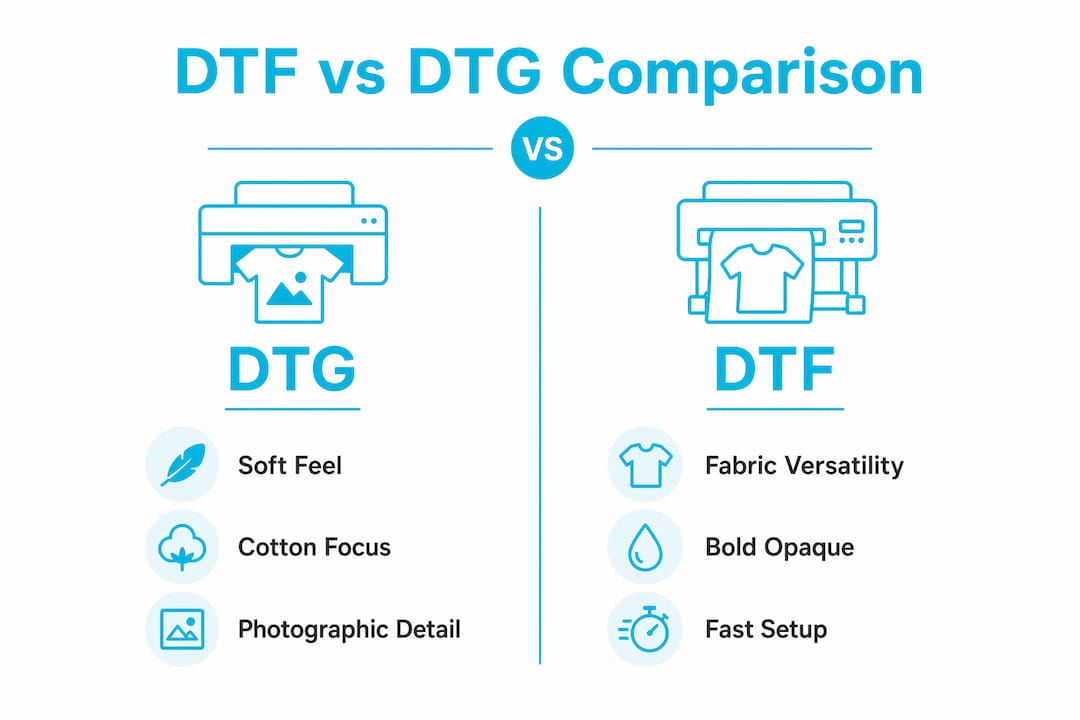
For most shoppers buying premium cotton graphic tees, DTG (direct-to-garment) is the better call. If your order mixes fabrics, runs dark, or spans polyester and blends, DTF (direct-to-film) wins on color and versatility. That’s the short version — here’s what it means in practice:
- Hand-feel: DTG inks sink into the fabric for a soft, barely-there finish. DTF sits on top as a thin film layer, which feels slightly stiffer at first but softens after a few washes.
- Fabric compatibility: DTG loves 100% cotton. DTF works on nearly anything — polyester, nylon, blends, and more.
- Color on dark garments: DTF’s opaque white underbase keeps colors vivid on black or navy. DTG can struggle with saturation on dark fabrics without careful pretreatment.
- Scale and cost: Per Arklavo’s buyer guide, DTF tends to be cheaper at scale; DTG is competitive for small cotton runs.
Industry sources including FESPA, Mimaki, and Imuskop’s own production experience all point to the same trade-off: soft and breathable versus bold and universal.
Table of Contents
- How does DTG printing work for shoppers?
- How does DTF printing work for shoppers?
- Head-to-head: what actually matters when you’re buying streetwear
- Which method fits your actual order?
- How to wash and care for DTG and DTF prints
- What to expect on price and turnaround
- How Imuskop approaches printing for graphic tees
- Quick checklist: DTG or DTF?
- Key Takeaways
- The real reason most buyers get this wrong
- Imuskop’s graphic tees: print quality built into every piece
- Sources and further reading
How does DTG printing work for shoppers?
DTG printing jets water-based inks directly into the garment’s fibers, producing a print that feels like part of the shirt rather than something applied on top. The result is a soft, breathable finish that French Press Custom describes as a “no-feel” finish on cotton — you barely notice it’s there.
The basic workflow:
- Design file is prepared and color-profiled for the printer
- Dark garments receive a liquid pretreatment to help ink bond to fibers
- The garment is loaded flat onto a platen and printed with CMYK plus white inks
- The print is heat-cured to lock the ink into the fabric
Pros: Exceptionally soft hand-feel, photographic detail, no visible layer on the shirt surface, excellent for bold graphics and fine text on cotton.
Cons: Kornit notes that the pretreatment step adds setup time and reduces throughput, making DTG less efficient for high-volume runs. Performance on polyester is limited because synthetic fibers don’t absorb the ink well.
Best fabrics: 100% cotton and cotton-rich blends (at least 60% cotton). Bamboo and linen also work well.
Pro Tip: Ask your printer whether they pretreat dark garments — skipping this step is the single most common reason DTG prints look washed out on black tees.
How does DTF printing work for shoppers?
DTF prints a design onto a special PET film first, then transfers it to the garment via heat press. Because the print never touches the fabric until the final press step, FESPA highlights that transfers can be produced, stored, and applied later — a flexibility DTG simply can’t match.
The basic workflow:
- Design is printed onto PET film using CMYK and white inks
- Hot-melt adhesive powder is applied and cured onto the printed film
- The finished transfer is heat-pressed onto the garment at the right temperature and pressure
- The film is peeled away, leaving the design bonded to the fabric surface
Pros: Works on virtually any material — polyester, nylon, blends, even some leather goods. Vivid, opaque colors on dark garments without a separate pretreatment step. Transfers can be pre-made and warehoused for fast fulfillment.
Cons: The print sits on top of the fabric as a thin layer, so large solid-fill designs can feel heavier and reduce breathability. Initial stiffness is common, though it fades with washing.
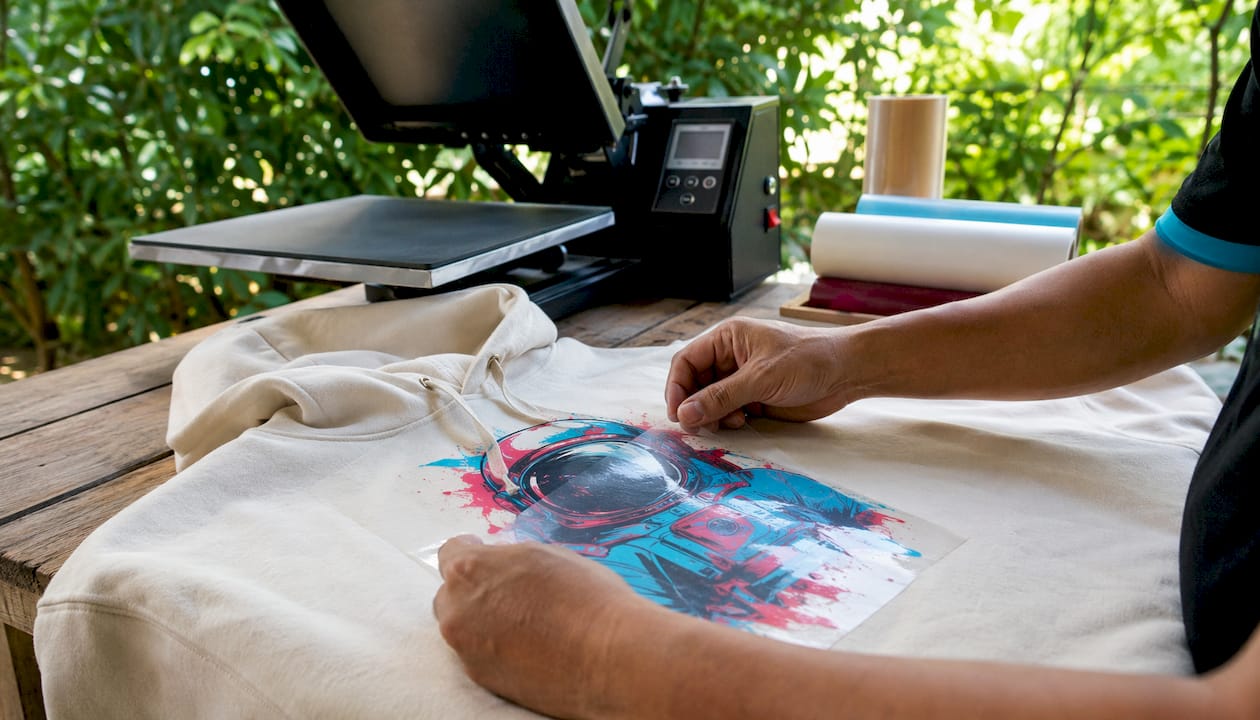
Best fabrics: Polyester, nylon, cotton-poly blends, fleece, and most synthetics. Mimaki also notes that heat-press application lets printers reach sleeves, pockets, and bags that DTG platens can’t accommodate.
Pro Tip: Avoid large, solid rectangular DTF blocks on panels that stretch heavily — like the chest of a fitted athletic hoodie. Detailed graphics and logos hold up far better than full-coverage fills.
Head-to-head: what actually matters when you’re buying streetwear
The core trade-off is simple: soft and embedded (DTG) versus bold, opaque, and universal (DTF). Everything else flows from that.
| Dimension | DTG | DTF |
|---|---|---|
| Best fabrics | Cotton, linen, bamboo | Polyester, nylon, blends, most synthetics |
| Color on dark garments | Needs pretreatment; can look muted | Opaque white underbase; stays vivid |
| Hand-feel | Soft, no-feel, breathable | Slight initial stiffness; softens after washing |
| Detail & resolution | Excellent for bold graphics; gradients can be tricky | Sharp on photos, fine art, gradients, small text |
| Workflow complexity | Pretreatment adds steps and time | Print-to-film then heat-press; no per-garment pretreat |
| Production speed | Slower per unit at volume | Faster at scale; transfers can be pre-produced |
| Wash durability | 40–60 washes under recommended care | 30–50 washes under recommended care |
| Best use-case | Premium cotton tee, soft-feel collectible | Mixed-fabric drop, dark garment, performance wear |
Wash durability figures are sourced from Arklavo’s buyer guide. DTG edges out DTF slightly on longevity under ideal care, but DTF’s elasticity makes it more resistant to cracking on stretch-prone garments.
Use-case pairs to keep in mind:
- Premium 100% cotton graphic tee with a bold logo → DTG
- Dark navy hoodie with a full-color photographic print → DTF
- Mixed streetwear drop spanning cotton tees and poly joggers → DTF for consistency
- Small run of 6–12 personalized cotton shirts → DTG is often more cost-effective
Which method fits your actual order?
Scenario-based guidance cuts through the noise faster than abstract comparisons.
- Single premium cotton tee: DTG. The soft hand-feel and embedded print are exactly what collectors and streetwear buyers expect from a quality piece.
- Limited-edition drop on dark garments: DTF. Opaque color and a consistent look across a full run, regardless of fabric color.
- Performance wear or sports jerseys: DTF. Polyester and moisture-wicking blends don’t absorb DTG inks reliably.
- Mixed-fabric order (tees + hoodies + joggers): DTF keeps the color consistent across every substrate without switching workflows mid-run.
- Small personalized run (under 12 pieces) on cotton: DTG, since there’s no film setup cost and the per-unit price stays reasonable.
- High-volume merch drop (100+ pieces): DTF typically wins on cost and speed at scale.
- Hybrid approach: Some brands use DTG for their core cotton tees and DTF for accessories, hoodies, and performance pieces. If your streetwear brand spans multiple fabric types, a hybrid strategy is worth discussing with your printer.
How to wash and care for DTG and DTF prints
Both methods hold up well when you treat them right. DTG prints last about 40–60 washes; DTF transfers withstand roughly 30–50 washes, both under recommended care, per Arklavo’s buyer guide.
Care rules for both methods:
- Wash inside-out on a gentle cycle in cold water
- Skip bleach and harsh detergents — they degrade both ink and adhesive
- Air-dry or use low heat in the dryer; high heat is the fastest way to crack a print
- Never iron directly on the print; use a pressing cloth or iron inside-out
Failure modes to know: DTG prints tend to fade gradually with repeated washing if care instructions are ignored. DTF prints are more prone to edge lift on heavily stretched panels, and large solid areas can develop fine cracks if washed in hot water.
Pro Tip: For a brand-new DTF transfer, the first wash is the most important. Cold water, gentle cycle, inside-out — get that one right and the print bonds more fully to the fabric.
What to expect on price and turnaround
DTF is generally cheaper per unit at volume; DTG is competitive for small cotton runs with no film setup cost. For a rough benchmark, small-run per-shirt costs for both methods tend to land in a similar range at low quantities, with DTF pulling ahead as order size grows — but exact pricing varies by printer, garment, and design complexity. Always request a quote with your specific specs.
What to include in your quote request:
- Garment type, fabric content, and color (light or dark)
- Artwork file format (vector preferred), dimensions, and placement
- Run size and whether you need individual names/numbers
- Post-print finishing requirements (folding, tagging, bagging)
Questions to ask your printer:
- Do you use a white underbase on dark garments for DTG?
- What pretreatment method do you use, and is it included in the price?
- What curing temperature do you use for DTF transfers?
- What wash instructions do you recommend for the first wash?
- Do you offer a sample print or press proof before the full run?
Production timelines vary, but most small runs complete in 3–7 business days. DTF has a slight edge when transfers are pre-produced and garments arrive in batches.
How Imuskop approaches printing for graphic tees
Imuskop selects print methods based on fabric first and design second — the same logic this article lays out. For the brand’s core cotton graphic tees, the priority is a soft, embedded finish that holds up wash after wash. For pieces spanning blends or darker colorways, the focus shifts to color fidelity and opacity.
Imuskop’s streetwear lineup covers original graphic tees, hoodies, joggers, flannel shirts, hats, socks, and accessories — pop culture, activism, and artistic designs across a range of fabrics. That mix is exactly why understanding both methods matters. Production choices are informed by industry guidance from FESPA and Mimaki, with attention to:
- Fabric-matched print method selection
- Color accuracy on both light and dark garments
- Soft-feel finish on cotton-based pieces
- Consistent quality across mixed-fabric drops
Shoppers also get free shipping on all orders and interest-free payment plans through Affirm, making it straightforward to order without upfront friction.
Quick checklist: DTG or DTF?
Choose DTG if you:
- Are buying a 100% cotton or cotton-rich tee
- Want the softest possible hand-feel
- Prefer a print that feels embedded, not applied
- Are ordering a small run of personalized cotton pieces
Choose DTF if you:
- Need vivid color on a dark or black garment
- Are ordering polyester, nylon, or a fabric blend
- Want consistent color across a mixed-fabric drop
- Are ordering at volume and want lower per-unit cost
Bottom line: Fabric first. If it’s cotton, lean DTG. If it’s anything else, or if the design is dark and color-heavy, DTF is the safer bet. When in doubt, ask your printer for a sample print or a digital mock-up before committing to a full run.
Key Takeaways
DTG is the right choice for soft-feel cotton tees; DTF wins on fabric versatility, dark-garment color, and cost at scale.
| Point | Details |
|---|---|
| Fabric determines method | DTG excels on cotton; DTF works on polyester, nylon, blends, and most synthetics. |
| Color on dark garments | DTF’s opaque white underbase keeps colors vivid; DTG needs careful pretreatment to match. |
| Wash durability | DTG lasts about 40–60 washes; DTF withstands roughly 30–50 washes under recommended care. |
| Cost at scale | DTF tends to be cheaper per unit at higher volumes; DTG is competitive for small cotton runs. |
| Imuskop’s approach | Imuskop matches print method to fabric and design, offering soft-feel cotton tees and multi-fabric streetwear with free shipping and interest-free payment plans. |
The real reason most buyers get this wrong
Most people shopping for graphic tees focus on the design and forget to ask about the fabric. That’s where the frustration comes from — a beautiful print that feels stiff or fades faster than expected, usually because the method didn’t match the substrate.
The DTG vs DTF debate isn’t really about which technology is better. It’s about whether your shirt is cotton or not, and whether the design needs to pop on a dark background. Get those two questions right and the method choice is almost automatic.
What’s underrated here is the hand-feel gap. DTG on a quality cotton tee feels genuinely different from a DTF transfer on the same shirt — not worse, just different. For streetwear buyers who care about how a piece wears over months, that tactile difference matters as much as the visual one. Ask for a sample. Wash it twice. Then decide.
Imuskop’s graphic tees: print quality built into every piece
Imuskop takes the guesswork out of print method selection. Every graphic tee and streetwear piece is matched to the right print process for its fabric and design — so you get the soft hand-feel on cotton pieces and bold, opaque color on darker garments without having to negotiate the technical details yourself.
Free shipping on every order. Interest-free payment plans through Affirm. Original designs spanning pop culture, activism, and urban art — built for people who want their clothes to say something. Browse the full collection and find your next piece at imuskop.com.
Sources and further reading
- FESPA — Pros and cons of DTF and DTG printing: DTF workflow, powder adhesive process, substrate versatility, and production flexibility.
- Mimaki — DTF vs DTG printing: Core trade-off framing (soft/embedded vs vivid/opaque), heat-press placement advantages.
- Mimaki Europe — DTF vs DTG: Pre-production transfer storage and distributed fulfillment models.
- Kornit — DTG print vs DTF print: Pretreatment workflow complexity and throughput comparison.
- Arklavo — DTF vs DTG ultimate guide: Per-unit cost ranges and wash durability estimates (30–50 washes DTF; 40–60 washes DTG).
- French Press Custom — DTG vs DTF: Hand-feel descriptions and dark-garment color performance.
- DTF Virginia — DTF vs DTG: Fabric compatibility breakdown (polyester, nylon, blends for DTF; natural fibers for DTG).
- Shopify — DTG vs DTF printing: Buyer-focused comparison dimensions and printer checklist guidance.