

What is pre-shrunk cotton, and does it actually prevent shrinkage?
Pre-shrunk cotton is fabric that has been mechanically stabilized before it’s cut and sewn into a garment. The most common method is sanforization, a process patented by Sanford Lockwood Cluett that uses moisture, heat, and pressure to compress cotton fibers into their most relaxed state at the mill level. The result is a shirt or hoodie that has already “used up” most of its shrinkage potential before it ever reaches your closet.
Here’s the key distinction: pre-shrunk does not mean shrink-proof. Untreated cotton can shrink significantly on the first wash. Properly pre-shrunk cotton limits that shrinkage considerably with cold-water care. That’s a meaningful difference, but not a guarantee of zero change.
What pre-shrunk cotton does and doesn’t do:
- Reduces first-wash shrinkage from a potentially large amount down to a smaller range
- Stabilizes fiber tension built up during high-speed knitting or weaving
- Does NOT eliminate residual shrinkage entirely
- Does NOT protect against heat above 60°C (140°F) in the wash or 70°C (160°F) in the dryer
- Labeled “pre-shrunk” means some compaction was applied; labeled “Sanforized®” means compaction met the Sanforized® tolerance standard
Table of Contents
- How fabric construction and finishing shape shrinkage behavior
- How to care for pre-shrunk cotton garments
- Benefits and limitations of pre-shrunk cotton in sustainable fashion
- What Imuskop brings to pre-shrunk cotton apparel
- Common misconceptions about pre-shrunk cotton
- How pre-shrunk cotton is manufactured
- How pre-shrunk cotton affects fit and sizing choices
- Key Takeaways
- Imuskop graphic tees are built for wearers who keep their clothes
How fabric construction and finishing shape shrinkage behavior
Shrinkage is controlled by fabric construction and finishing, not by the yarn spinning method. Whether a shirt is made from ring-spun or open-end cotton tells you nothing about how much it will shrink. The finishing process is what matters.
Two main finishing methods handle pre-shrinking:
- Sanforization (woven fabrics): mechanical compression holds residual shrinkage to ≤1% per the Sanforized® specification (SANFOR GmbH, measured under ISO 6330). Used for denim, twill, and poplin.
- Compactor finishing (knit fabrics): a similar rubber-blanket compression adapted for jersey and circular knits. Sanforized® tolerance here is ≤5% residual shrinkage.
- Garment dyeing: sewn garments pass through hot dye baths that absorb most relaxation shrinkage during processing, typically leaving 1–3% residual.
Knit fabrics shrink more than wovens by nature. Jersey construction has more dimensional flexibility than interlock, so a jersey tee will always sit closer to that 5% ceiling than a woven poplin shirt. Fabric weight also plays a role: heavier GSM fabrics tend to hold their dimensions better after pre-shrinking.
How to care for pre-shrunk cotton garments
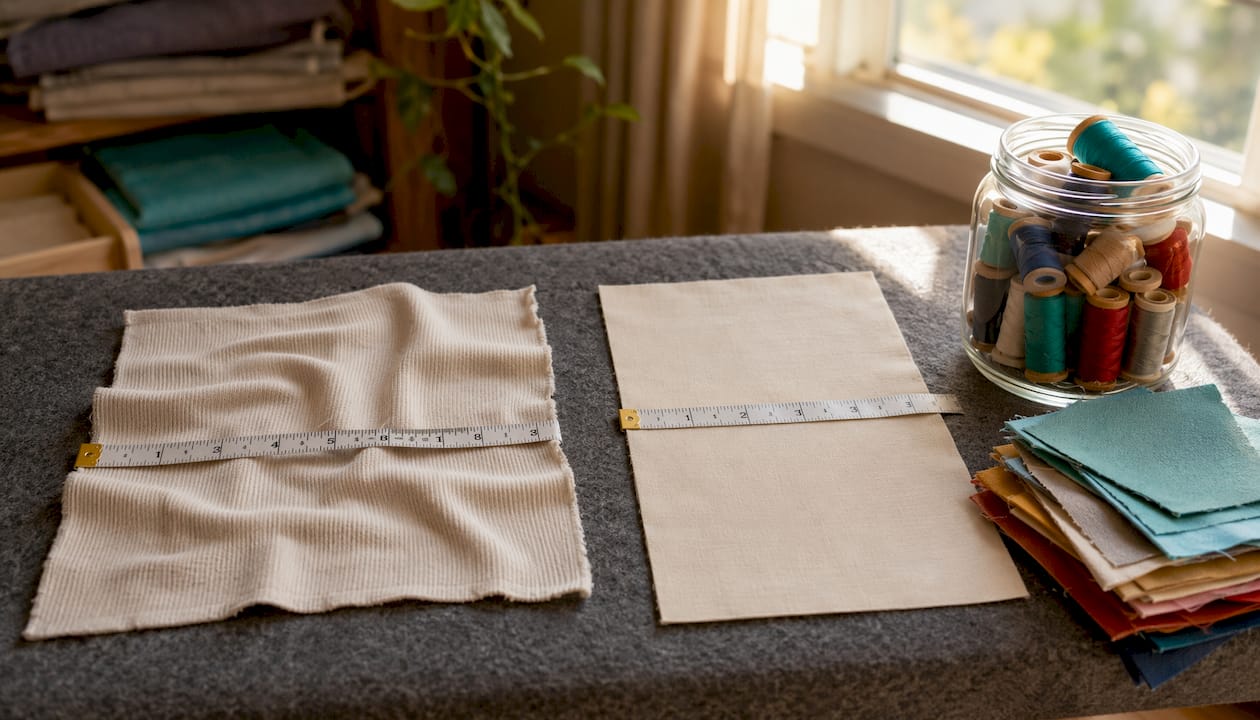
Cold water is your single most effective tool. Washing at 20–30°C (68–86°F) keeps fiber swelling minimal and produces negligible additional shrinkage. Hot water at 60–90°C does the opposite, causing fibers to swell and contract as they dry.
Care practices that protect garment dimensions:
- Wash in cold water (68–86°F) on a gentle or delicate cycle
- Air-dry or tumble dry on low heat to avoid the 70°C+ threshold that triggers further shrinkage
- Never wring or twist wet cotton; handle it gently to prevent uneven distortion
- Check the care label before every wash since fabric weight and construction affect the right settings
Pro Tip: If a pre-shrunk garment still feels slightly tight after washing, reshape it while damp and lay it flat to dry. Most residual shrinkage is consumed in the first one to three washes, so the fit stabilizes quickly.
Benefits and limitations of pre-shrunk cotton in sustainable fashion
Pre-shrunk cotton delivers real advantages for anyone who cares about garment longevity. Fabric weight increases somewhat after pre-shrinking as fibers become more densely packed, which improves both softness and durability. The stabilized fit also means fewer returns and less waste from garments that no longer fit after one wash cycle.
Benefits:
- Predictable sizing across multiple washes
- Denser, softer hand feel compared to untreated cotton
- Fewer returns due to fit consistency, which supports sustainable production goals
- Longer garment life from stabilized fiber structure
Limitations:
- Residual shrinkage of up to 5% remains possible, particularly in knit constructions
- Heat above 60°C can trigger additional shrinkage despite pre-treatment
- “Pre-shrunk” is a tolerance range, not a precise specification; actual performance varies by manufacturer
Pre-shrunk cotton supports sustainable fashion goals by extending the useful life of a garment and reducing the churn of ill-fitting clothes that end up discarded. It’s not a chemical fix, which matters to consumers who prefer mechanical over resin-based treatments.
What Imuskop brings to pre-shrunk cotton apparel
Imuskop builds its graphic tees and streetwear on pre-shrunk cotton because fit consistency is non-negotiable when the design is the point. A shirt that shrinks two sizes after the first wash undermines the artwork as much as it undermines the customer.
Imuskop pairs that material standard with free shipping on all orders and interest-free payment plans through Affirm, making quality streetwear accessible without the usual trade-offs. The brand’s focus on activism-driven and pop-culture designs means the fabric has to perform as well as the print.
Common misconceptions about pre-shrunk cotton
The biggest one: “pre-shrunk” means “shrink-proof.” It doesn’t. Pre-shrunk is a mitigation process, not a guarantee. A garment labeled pre-shrunk can still shrink up to 5% under the wrong conditions.
A second misconception is that ring-spun cotton is inherently more shrink-resistant than other cotton types. Ring spinning describes how the yarn is made, not how the fabric is finished. A ring-spun tee with no finishing treatment will shrink more than an open-end tee that has been properly sanforized.
Third: cotton blends don’t shrink. Blends with polyester shrink less than 100% cotton, but they still shrink when exposed to high heat.
How pre-shrunk cotton is manufactured
Sanforization works by feeding damp fabric between a rubber sleeve and a heated rotating cylinder. The sleeve stretches, then contracts, forcing the cloth to shrink in a controlled way before it’s ever cut into panels. Once the fibers are compressed, there’s very little tension left to release in a home washer.
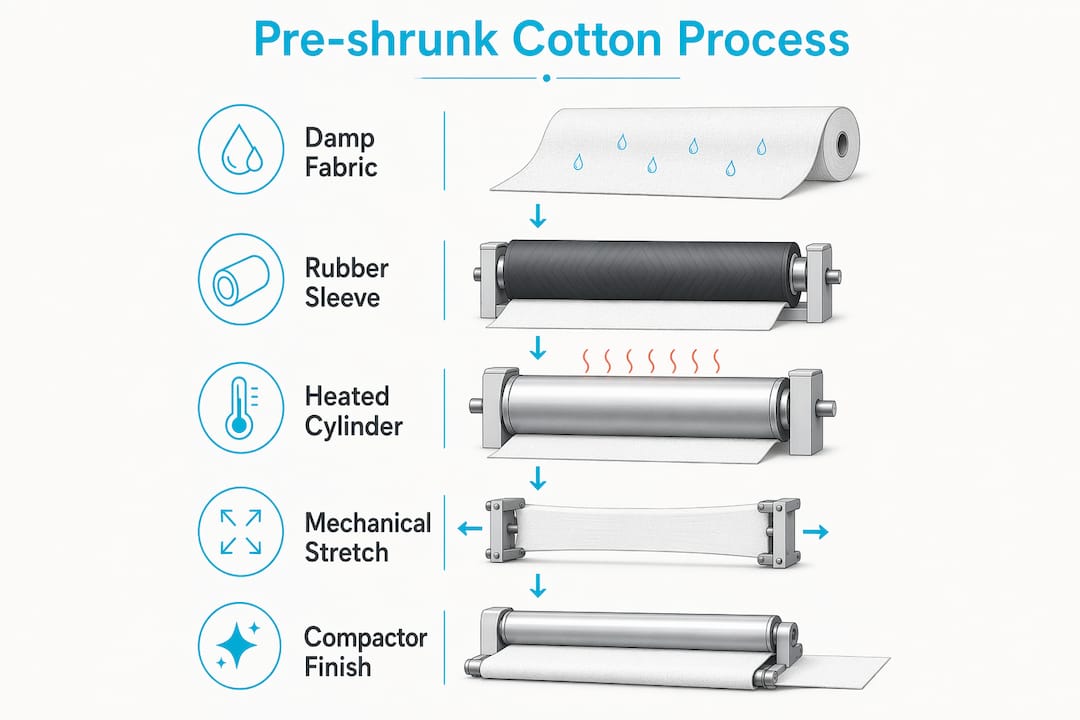
Compactor finishing applies the same principle to knit fabrics using steam and mechanical force. Garment dyeing takes a different route: finished garments go through hot dye baths that absorb relaxation shrinkage during the dyeing process itself. Each method targets the same root cause, which is built-in fiber tension from the manufacturing process.
How pre-shrunk cotton affects fit and sizing choices
Pre-shrunk cotton lets you buy your actual size. With untreated cotton, experienced shoppers often size up to account for expected shrinkage. Pre-shrunk fabric removes that guesswork for most washes, though a small residual allowance (up to 5% in knits, or ≤1% for well-finished wovens) is still worth keeping in mind for fitted styles.
For graphic tees and streetwear, where the cut and drop of a shirt affect how a design reads visually, that sizing predictability matters. Check the latest shirts for size guides built around pre-shrunk dimensions.
Key Takeaways
Pre-shrunk cotton reduces first-wash shrinkage from up to 20% down to under 5%, but cold-water washing and low-heat drying are still required to maintain garment dimensions.
| Point | Details |
|---|---|
| Shrinkage is reduced, not eliminated | Pre-shrunk cotton limits shrinkage to 1–5%, versus 10–20% for untreated cotton. |
| Finishing method determines performance | Sanforized wovens hold to ≤1% residual; compacted knits hold to ≤5% per ISO 6330. |
| Heat is the main risk | Washing above 60°C or drying above 70°C triggers additional shrinkage even in pre-shrunk garments. |
| Fabric weight increases after pre-shrinking | Fiber compaction raises fabric weight, improving density and softness. |
| Imuskop uses pre-shrunk cotton | Imuskop’s graphic tees and streetwear are built on pre-shrunk cotton for stable fit and lasting print quality. |
Imuskop graphic tees are built for wearers who keep their clothes
If you’ve read this far, you already know that fabric quality is the foundation of a garment worth keeping. Imuskop’s pre-shrunk cotton t-shirts and streetwear are designed for people who want bold designs on fabric that actually holds its shape. No sizing up to compensate for shrinkage. No fading graphics after three washes.
Every order ships free, and Affirm’s interest-free payment plans mean you can stock up without the upfront hit. Browse the full collection at imuskop.com and find the fit that stays a fit.