

If you want ethical organic cotton streetwear you can trust, start with one check: does the product page show a GOTS certification logo, a named factory location, and a clear “grown & sewn in USA” statement? Those three signals, taken together, separate genuine American-made pieces from brands that borrow the language without the proof. Imuskop is one American-made option worth bookmarking before you read further.
Before you buy anything, run through this quick filter:
- Look for the GOTS (Global Organic Textile Standard) logo or a certificate link on the product page.
- Confirm the brand lists a specific factory location, not just “ethically made.”
- Check for a Fair Trade certification if farm-level labor conditions matter to you.
- Read the care label for fiber content and country of origin.
- Verify the price reflects the real cost of certified organic production (more on that below).
Research from The Good Trade consistently show that GOTS-certified pieces are the safest starting point because the standard covers both fiber quality and social manufacturing criteria, not just the farming side.
Key Takeaways
American-made organic cotton streetwear requires GOTS certification, factory-level transparency, and a clear domestic origin claim to be worth the price premium.
| Point | Details |
|---|---|
| GOTS is the baseline | Look for a GOTS logo with a certificate link; it covers fiber, chemicals, manufacturing, and labor in one audit. |
| “Grown & sewn in USA” beats “Made in USA” | The stronger claim requires domestic fiber and domestic manufacturing, not just domestic assembly. |
| Price reflects real costs | Certified organic tees typically run $35–$65; hoodies $80–$150. Prices below that range warrant scrutiny. |
| Care extends sustainability | Cold wash, air-dry, and reshape while damp to double a garment’s useful life and lower its total footprint. |
| Imuskop is a recommended option | Imuskop offers American-made graphic tees, hoodies, joggers, and accessories with free shipping and Affirm payment plans. |
Table of Contents
- What does “organic cotton” actually mean for streetwear?
- Which certifications actually matter on a product page?
- What does “Made in USA” or “grown & sewn in USA” actually require?
- What streetwear items come in organic cotton, and what should you expect?
- How do you evaluate an organic-cotton streetwear product page before buying?
- How to care for organic-cotton streetwear so it actually lasts
- Imuskop: an American-made organic cotton streetwear brand worth knowing
- Imuskop brings style and sustainability together for American shoppers
- Sources
What does “organic cotton” actually mean for streetwear?
Organic cotton is grown without synthetic pesticides, herbicides, or genetically modified seeds. That distinction matters beyond the farm. Research published in peer-reviewed literature and analyses from The Organic Center show organic cotton frequently reduces certain environmental impacts, particularly pesticide load, though outcomes vary by region and farming practice.
For the person wearing the shirt, the practical difference shows up in a few ways. Organic cotton fibers tend to retain more of their natural wax coating because they skip the harsh chemical processing that strips conventional cotton. The result is a softer hand feel, especially after a few washes. There’s also lower residual chemical exposure against your skin, which matters if you wear a tee for hours at a stretch.
Here’s the part most shoppers miss: “organic” on a label covers the fiber only. It says nothing about how the garment was dyed, finished, or sewn. A shirt made from certified organic cotton can still be treated with azo dyes or assembled in a facility with poor labor conditions. That gap is exactly why third-party certification exists.
- Fiber quality: Organic cotton is typically longer-staple and less processed, which contributes to a softer, more durable yarn.
- Chemical exposure: No synthetic pesticide residues on the fiber, and often lower formaldehyde in finishing when paired with responsible dyeing.
- Traceability: Organic supply chains tend to be shorter and better documented, making it easier for brands to publish farm-to-shelf transparency.
- Environmental footprint: Lower synthetic pesticide use is the most consistent benefit; water use depends heavily on irrigation practices.
Pro Tip: When you’re reading a product page, look for fabric construction terms alongside the organic claim. Combed ring-spun cotton in the 160–220 GSM range signals a retail-quality tee that will hold its shape. Open-end carded cotton at a low GSM is cheaper to produce and shows it after a dozen washes.
Which certifications actually matter on a product page?
Not all certification logos carry the same weight. Here’s how to read the ones you’ll encounter most often.
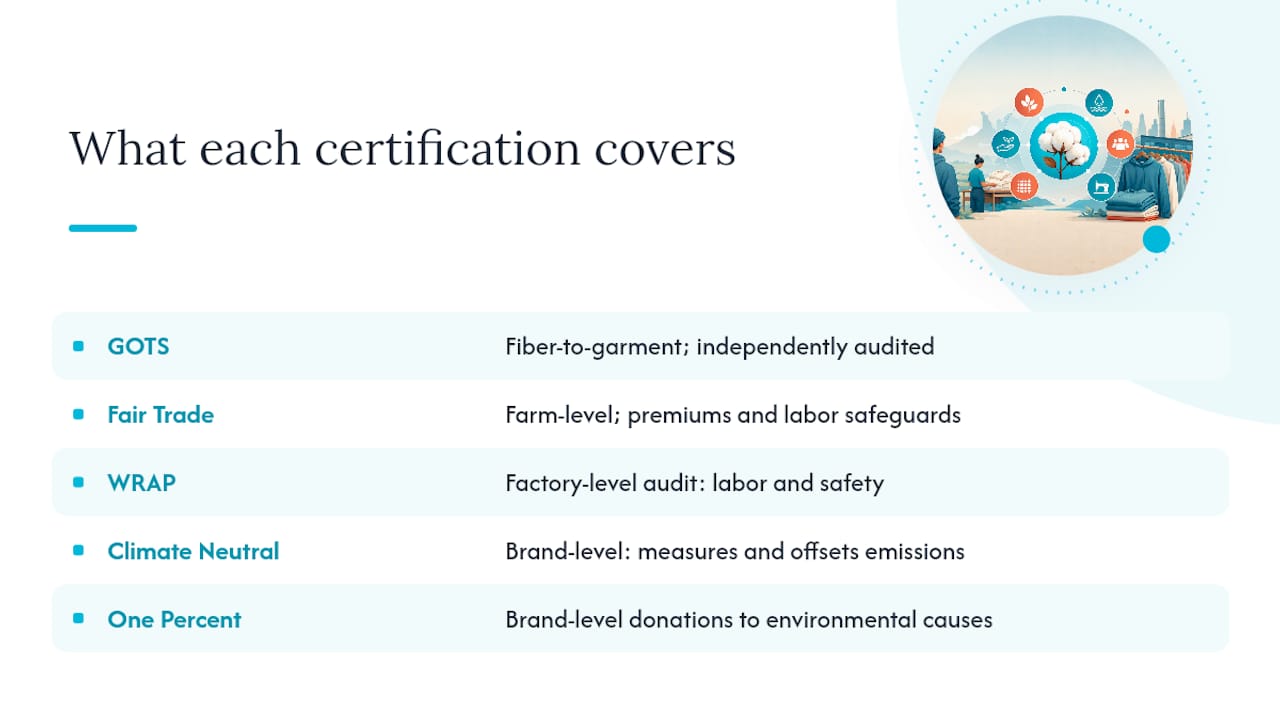
GOTS is the gold standard for organic apparel. It covers the full processing chain from raw fiber to finished garment, including limits on toxic inputs, wastewater treatment requirements, and social compliance criteria for workers. A brand that displays a valid GOTS certificate has been audited by an independent body, not just self-declared. That’s the difference between a logo and a claim.
Fair Trade works at the farm and community level. Fair Trade certification indicates that farmers receive premiums above commodity prices and that stronger labor safeguards apply at the source. It complements GOTS rather than replacing it: GOTS focuses on fiber and manufacturing; Fair Trade focuses on the people growing the cotton.
WRAP operates at the factory level. The WRAP program audits sewing and finishing facilities for humane labor practices, health standards, and workplace safety. A brand that publishes its WRAP certificate or factory audit summary is giving you something concrete to verify, not just a mission statement.
Climate Neutral and One Percent for the Planet are brand-level commitments. Climate Neutral verifies that a brand has measured and is offsetting or reducing its emissions. One Percent for the Planet means the brand donates a percentage of revenue to environmental causes. Both are meaningful, but neither tells you anything about the cotton fiber or the factory floor. Read them as complementary signals, not substitutes for GOTS or WRAP.
Pro Tip: The clearest red flag on any product page is the phrase “we use organic cotton” with no certification logo and no link to a certificate. Any brand that has earned GOTS or Fair Trade certification will display it prominently because they paid for the audit. Vague language without a cert link almost always means the claim is unverified.
What does “Made in USA” or “grown & sewn in USA” actually require?
These phrases are not interchangeable, and the gap between them is significant.
“Made in USA” under Federal Trade Commission guidelines means all or virtually all of the product was made in the United States. That includes manufacturing, but it does not require that the raw fiber was grown domestically. A brand can legally label a garment “Made in USA” while using cotton grown in India or Turkey, as long as the cutting and sewing happened stateside.
“Grown & sewn in USA” is a stronger claim. It means the cotton was farmed in the U.S. (most commonly in Texas, California, or the Southeast) and the garment was also manufactured domestically. That’s a genuinely short supply chain, and it’s harder to fake because it requires documentation at both the farm and factory level.
“Assembled in USA” is the weakest of the three. It typically means components were imported and put together domestically. For a T-shirt, that often means the fabric was cut and sewn overseas and finished or labeled in the U.S.
How to verify a brand’s origin claim
- Find the product’s care label or origin statement. It must state country of manufacture by law.
- Look for a named mill or factory, not just a city or country. Specific names are verifiable; vague geography is not.
- Check whether the brand publishes a supply-chain map, factory photos, or audit reports. These take real effort to produce and are a strong signal of genuine transparency.
- Search the brand’s factory name against WRAP’s public database or Sedex’s public listings.
- Email the brand directly and ask: “Where is this garment cut and sewn, and can you share the factory’s certification?” A brand with nothing to hide answers quickly and specifically.
What streetwear items come in organic cotton, and what should you expect?
The organic cotton streetwear category has expanded well beyond basic tees. Here’s what to look for across the main product types.
T-shirts are the most common entry point. A quality organic cotton tee sits in the 160–220 GSM range. Below 160 GSM, the fabric tends to feel thin and loses shape quickly. Combed ring-spun construction produces a smoother, softer surface than open-end carded cotton and holds printed graphics better over time. Pima or Supima cotton, when certified organic, offers an even longer staple and a noticeably silkier hand.
Hoodies and sweatshirts in organic cotton typically run 280–400 GSM. French terry (a looped-back knit) is lighter and more breathable; loopback fleece is heavier and warmer. Drop-shoulder and oversized cuts are popular in streetwear right now, and they actually age better than slim fits because there’s less stress on the seams at the shoulder and underarm. Look for double-needle stitching at the hem and cuffs as a durability indicator.
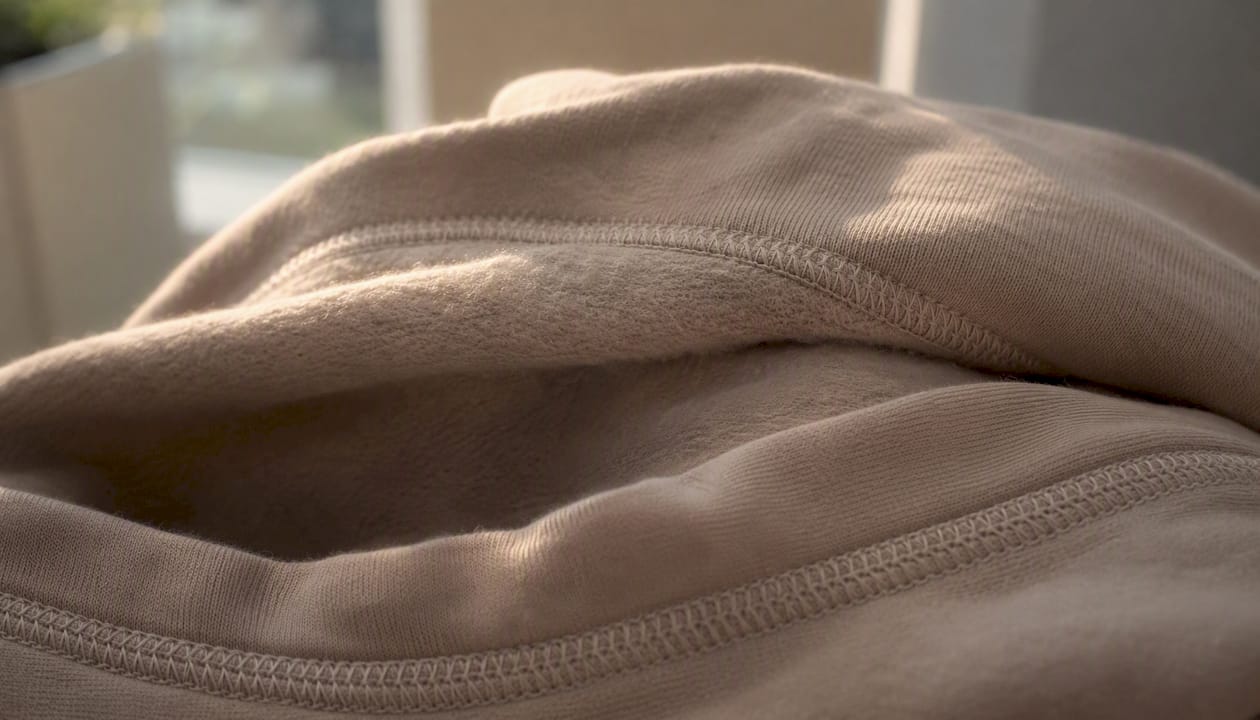
Joggers need structure to hold their shape through repeated washing. Reinforced seams at the crotch and inseam, a ribbed waistband with a drawstring, and a fabric weight above 280 GSM are the practical markers of a jogger that lasts more than a season.
Accessories like hats and tote bags often carry organic cotton claims, but the percentages vary. A hat brim might be organic cotton twill while the sweatband is conventional.
Pro Tip: For graphic tees specifically, a tighter yarn construction (higher singles count, combed) holds screen-printed or DTG-printed artwork sharper for longer. A loose, open weave absorbs ink unevenly and the print cracks faster. If the brand doesn’t list yarn construction, the GSM alone won’t tell you enough.
How do you evaluate an organic-cotton streetwear product page before buying?
Use this checklist before you check out. It takes about two minutes per product and saves a lot of post-purchase regret.
Quick verification checklist:
- Certification logo: Is GOTS, Fair Trade, or an equivalent third-party cert displayed with a link to the certificate?
- Factory location: Does the brand name a specific facility, not just a country?
- Raw-material origin: Is the cotton sourced from a named farm or region, or is it vaguely “organic”?
- Dyeing and finishing: Does the product page mention non-toxic or low-impact dyes? GOTS certification covers this, but non-GOTS brands should still disclose it.
- Care label: Does it list fiber content, country of origin, and washing instructions?
- Price: Does the price reflect real production costs? (See below.)
- Return/repair policy: Does the brand stand behind the garment’s durability?
- Customer reviews: Do reviews mention longevity, not just aesthetics?
On price: authentic GOTS-certified, American-made organic cotton pieces cost more than fast-fashion alternatives. A basic tee from a certified domestic brand typically costs more than mass-market alternatives. Hoodies usually carry a price premium reflecting higher manufacturing standards. If a brand is selling “organic cotton” tees at $12, something in the supply chain isn’t adding up. For a broader look at affordable streetwear options at different price points, Imuskop’s editorial covers the spectrum honestly.
Direct-to-consumer brands with published supply-chain details are the safest place to shop. Vetted boutiques that curate certified brands are a solid second option. Marketplaces with third-party sellers require more scrutiny because certification claims are harder to verify at scale.
How to care for organic-cotton streetwear so it actually lasts
Longevity is sustainability. A garment that lasts five years instead of two cuts its environmental footprint roughly in half, regardless of how it was made.
- Wash cold. Hot water breaks down cotton fibers faster and causes shrinkage. A 30°C (86°F) or cold cycle is sufficient for most streetwear.
- Use a mild, non-bleach detergent. Enzyme-heavy detergents and bleach degrade the fiber and strip natural dyes. A fragrance-free, plant-based detergent is the safest choice for organic cotton.
- Skip the fabric softener. Softeners coat cotton fibers with a waxy film that reduces breathability and, over time, weakens the yarn. The natural softness of organic cotton doesn’t need it.
- Air-dry when possible. High dryer heat is the fastest way to shrink and pill a cotton garment. Lay heavy knits flat to dry so they reshape correctly.
- Reshape while damp. Pull hoodies and joggers back to their original dimensions right after washing, before they set in a distorted shape.
- Store folded, not hung. Hanging heavy cotton knits stretches the shoulder seams over time. Fold and stack them.
- Mend early. A small seam separation or a loose thread costs five minutes to fix. Left alone, it becomes a tear that ends the garment’s life.
Pro Tip: The single habit that prevents most early wear problems: cool wash, reshape immediately, hang to dry on a wide hanger or lay flat. Do that consistently and a quality organic cotton hoodie will look good for years.
Imuskop: an American-made organic cotton streetwear brand worth knowing
Imuskop is a direct-to-consumer American streetwear brand built around original graphic design and quality construction. The product range covers the core categories eco-conscious shoppers look for in this space:
- Graphic tees: Original artwork across pop culture, activism, and subculture themes, available in quality cotton construction suited for everyday wear.
- Hoodies and sweatshirts: Heavier-weight options designed for the kind of layering that defines American streetwear aesthetics.
- Joggers: Structured cuts with reinforced construction for durability beyond a single season.
- Accessories: Hats, socks, bags, and add-ons that round out a complete look.
Imuskop ships free on all orders and offers interest-free payment plans through Affirm, which makes the price premium of quality construction more accessible. For shoppers who care about the intersection of ethical streetwear and original design, that combination of accessibility and artistic identity is a genuine differentiator. The brand’s editorial content also covers sustainable style in men’s fashion and women’s ethical selections, so you can read about the brand’s sourcing philosophy before you buy.
Visit Imuskop to inspect product pages, check current certification and origin details, and browse the full range.
Why American-made organic cotton matters more than the label suggests
The certification conversation tends to focus on what’s printed on the tag, but the more interesting question is what happens when a brand can’t show you the factory. American-made organic cotton streetwear isn’t just a feel-good claim. It’s a verifiable supply chain. When a brand names a domestic mill, you can look it up. When they list a WRAP-certified factory in a U.S. city, you can confirm it. That accountability loop doesn’t exist when production is offshore and the only documentation is a PDF the brand wrote itself.
The other thing worth saying plainly: organic cotton without supply-chain transparency is a half-measure. The fiber might be clean, but if the finishing facility uses azo dyes and the workers aren’t paid fairly, the “organic” label is doing a lot of moral work it hasn’t earned. The brands worth supporting are the ones that publish the full picture, not just the part that photographs well. That’s the standard Imuskop holds itself to, and it’s the standard you should hold every brand to.
Imuskop brings style and sustainability together for American shoppers
Eco-conscious shoppers shouldn’t have to choose between a graphic tee that actually looks good and one they can feel good about buying. Imuskop builds both into the same product: original artwork on quality American-made construction, with free shipping and Affirm payment plans so the price of doing things right doesn’t price you out.
Whether you’re building a wardrobe around current streetwear trends or looking for a single statement piece that holds up, Imuskop’s product range covers tees, hoodies, joggers, and accessories with the kind of design identity that makes sustainable fashion worth wearing. Browse the full collection and check origin and certification details directly on each product page at Imuskop.
Sources
- I Tested The Best Organic Cotton T-Shirts For 2026 - The Good Trade
- Fairtradecertified
- Wrapcompliance
- Organic-center