

Garment-dyed t-shirts are sewn first, then submerged in a dye bath as a finished garment, which gives them a soft, broken-in feel and that slightly uneven, vintage color you can’t fake with standard dyeing. Imuskop carries garment-dyed tees with free shipping across the U.S., so if you’re ready to buy, that’s your first stop. If you want to know exactly what you’re getting before you add to cart, read on.
Key Takeaways
Garment-dyed t-shirts offer a soft, vintage hand-feel and tonal color depth that standard piece-dyed tees can’t replicate, making them worth the modest price premium for everyday wear.
| Point | Details |
|---|---|
| What “garment dyed” means | The tee is fully sewn first, then dyed, producing a broken-in feel and tonal color variation at seams. |
| Specs to check | Look for 100% cotton, medium weight, cotton thread, and a ribbed cotton collar on any product page. |
| Shrinkage stability | The high-heat dye wash pre-shrinks the fabric, so post-purchase shrinkage is generally minimal. |
| Care basics | Wash cold inside out, avoid bleach, and hang dry or use low heat to preserve color. |
| Where to buy | Imuskop offers garment-dyed tees with free U.S. shipping, Affirm payment plans, and detailed product specs. |
Table of Contents
- What do garment-dyed t-shirts actually look and feel like?
- What fabric specs and construction details should you check?
- What are the real pros and cons of garment-dyed tees?
- How does the garment dyeing process actually work?
- How should you wash and size garment-dyed tees?
- What should you check before buying a garment-dyed tee?
- What separates a high-quality garment-dyed tee from a mediocre one?
- Why garment dyeing deserves more credit than it gets
- Garment-dyed tees at Imuskop: what you get and how to order
- Sources
What do garment-dyed t-shirts actually look and feel like?
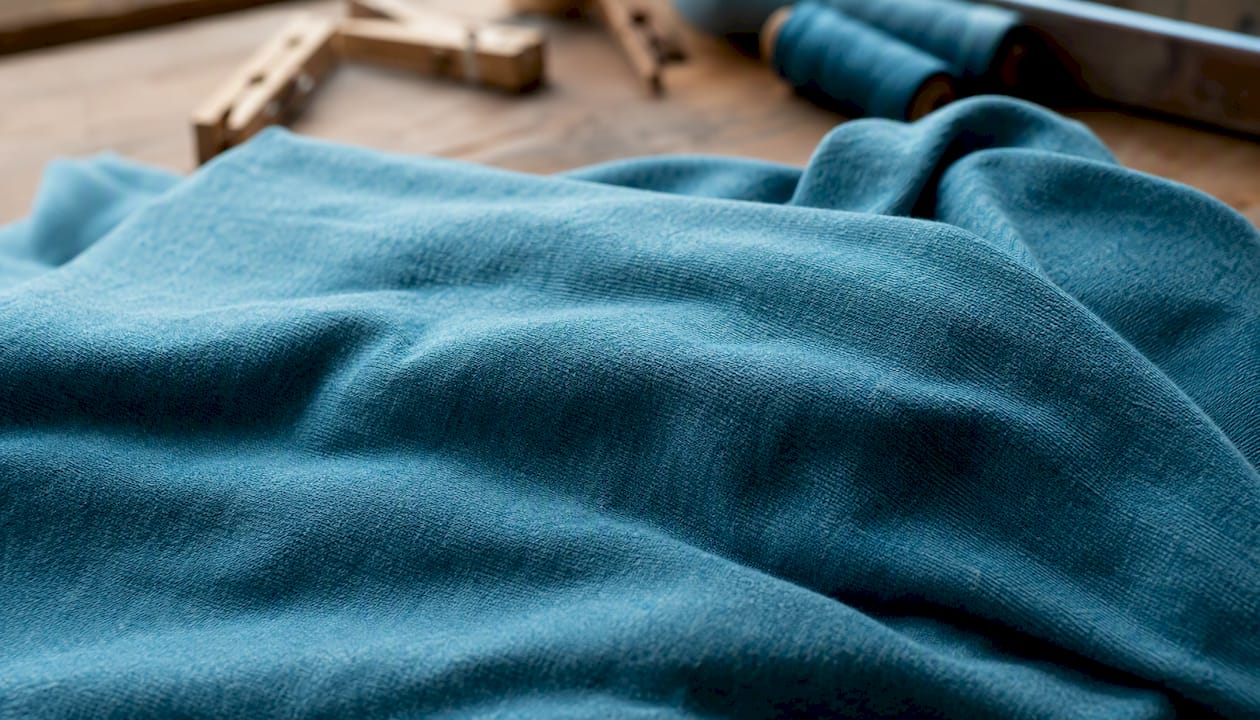
According to MR PORTER’s Journal, garment dyeing produces a softer, vintage-like finish where color pools in creases and highlights seams. That’s the look. The feel is equally distinct: Levi’s Off The Cuff blog notes that garment-dyed pieces are typically brushed and washed after dyeing, so they arrive with a broken-in hand-feel straight out of the bag.
Here’s what to expect on a typical product page:
- Fabric: 100% cotton or ring-spun cotton (ring-spun is finer, softer, and holds dye more evenly)
- Weight: Typically medium weight fabric suitable for everyday wear; lighter weights tend to drape better while heavier weights offer greater durability
- Hand-feel: Noticeably softer than a standard piece-dyed blank, with a slight texture from the wash step
- Color: Tonal, not flat; seams and collar edges will read slightly lighter or darker than the body
- Stitch details: Look for double-needle hems and reinforced shoulder seams on quality pieces
Check the product page for a country of finish statement. U.S.-finished tees often signal tighter QC on the dye process.
What fabric specs and construction details should you check?
Cotton takes garment dye predictably because its cellulose fibers absorb reactive and direct dyes evenly. A cotton-rich fleece (80/20 cotton-polyester) can work, but the polyester fraction will stay lighter, creating a subtle heather effect.
| Spec | What to look for | Why it matters |
|---|---|---|
| Fabric content | 100% cotton | Higher cotton = more even dye absorption |
| Fabric weight | Medium weight fabric for everyday wear | Heavier fabrics tend to hold shape better after repeated washing |
| Collar construction | Ribbed cotton collar (not polyester rib) | Cotton rib dyes to match; polyester rib stays lighter |
| Thread type | Cotton or cotton-wrapped thread | Polyester thread resists dye and may show as contrast stitching |
| Stitch density | Double-needle hem, 5–6 stitches per cm | Tighter stitching survives the dye bath without puckering |
As White Cotton’s comparison guide explains, polyester sewing thread will often resist dye and can appear as mismatched stitching if the brand didn’t specify dye-compatible thread. That’s a detail worth checking on any product page. For a deeper look at how fabric choice affects print compatibility on tees, this cotton vs. polyester breakdown covers the trade-offs clearly.
What are the real pros and cons of garment-dyed tees?
Pros:
- Soft, worn-in feel from day one, no break-in period required
- Tonal depth and seam variation that looks intentional, not accidental
- Smaller color-batch minimums compared to piece-dyeing, which benefits small labels and limited drops
- Reduced fabric inventory risk: brands can hold undyed stock and dye to order
- Generally more dimensionally stable after purchase because the high-heat dye wash pre-shrinks the fabric
Cons:
- Color can vary between pieces in the same dye lot; two “sage” tees from the same order may read slightly differently
- Very dark or extremely bright colors are harder to achieve consistently with garment dyeing, per White Cotton’s analysis
- Trims, threads, and labels must be dye-compatible or the contrast will be visible
- Per-unit cost runs higher than standard piece-dyed blanks
On shrinkage: because garment-dyed clothing goes through a high-heat washing process during the dye stage, Moss’s Inside Pocket confirms these pieces are generally more stable and less prone to significant shrinking during home laundering than standard undyed items.
How does the garment dyeing process actually work?
The sequence is straightforward, but each step introduces variables that affect the final look:
- Cut and sew — the tee is fully constructed, including all trims and labels
- Dye bath — the finished garment goes into a rotating drum with dye, water, and fixatives at high heat
- Rinse and neutralize — excess dye is removed; pH is balanced to stop the reaction
- Softening wash — a brushing or enzyme wash step adds the broken-in texture
- Dry and finish — the tee is dried, inspected, and folded
Seams, collars, and ribbing absorb dye differently because their fiber content and thread density differ from the main body fabric. That’s not a defect. It’s the signature of the process, and most brands design around it intentionally.
| Factor | Garment dyeing | Piece dyeing |
|---|---|---|
| When color is applied | After construction | Before cutting/sewing |
| Color variation at seams | Yes, intentional | Minimal |
| Shrinkage pre-treatment | Built into dye process | Requires separate pre-wash |
| Color range | Best for muted, earthy tones | Full spectrum possible |
| Small-batch flexibility | High | Lower |
How should you wash and size garment-dyed tees?
Care:
- Wash cold, inside out, with like colors
- Avoid harsh detergents or bleach; they strip reactive dyes faster
- Hang dry or tumble dry on low heat
- Skip the dryer for the first few washes to lock in the color
Sizing:
Most garment-dyed tees are pre-washed during production, so dramatic post-purchase shrinkage is unlikely. Still, check the brand’s size chart rather than assuming your usual size. Chest width and body length are the two measurements that matter most for a relaxed fit. If a brand offers a fit sample or detailed model measurements, use them. For a full breakdown of current fit styles and how to read a t-shirt size chart, Imuskop’s men’s fashion t-shirt guide covers it well.
What should you check before buying a garment-dyed tee?
Use this checklist on any product page:
- Material and weight — confirm 100% cotton or high-cotton content and a fabric weight listed in ounces
- Labeled dye process — the listing should say “garment dyed” explicitly, not just “washed” or “vintage finish”
- Thread and trim compatibility — look for product images showing seams and collar; matching dye on interior tags is a strong quality signal
- Clear size chart — chest and length measurements, not just S/M/L
- Shipping and returns — free shipping and a clear return window reduce risk on a first order
- Price — garment-dyed tees typically cost more per unit than standard piece-dyed blanks; that premium reflects the extra production step
Pro Tip: Check product photos for seam and collar close-ups. If the stitching reads as a clean contrast color rather than a random mismatch, the brand used dye-compatible thread intentionally. That’s a sign of production awareness, not a flaw.
What separates a high-quality garment-dyed tee from a mediocre one?
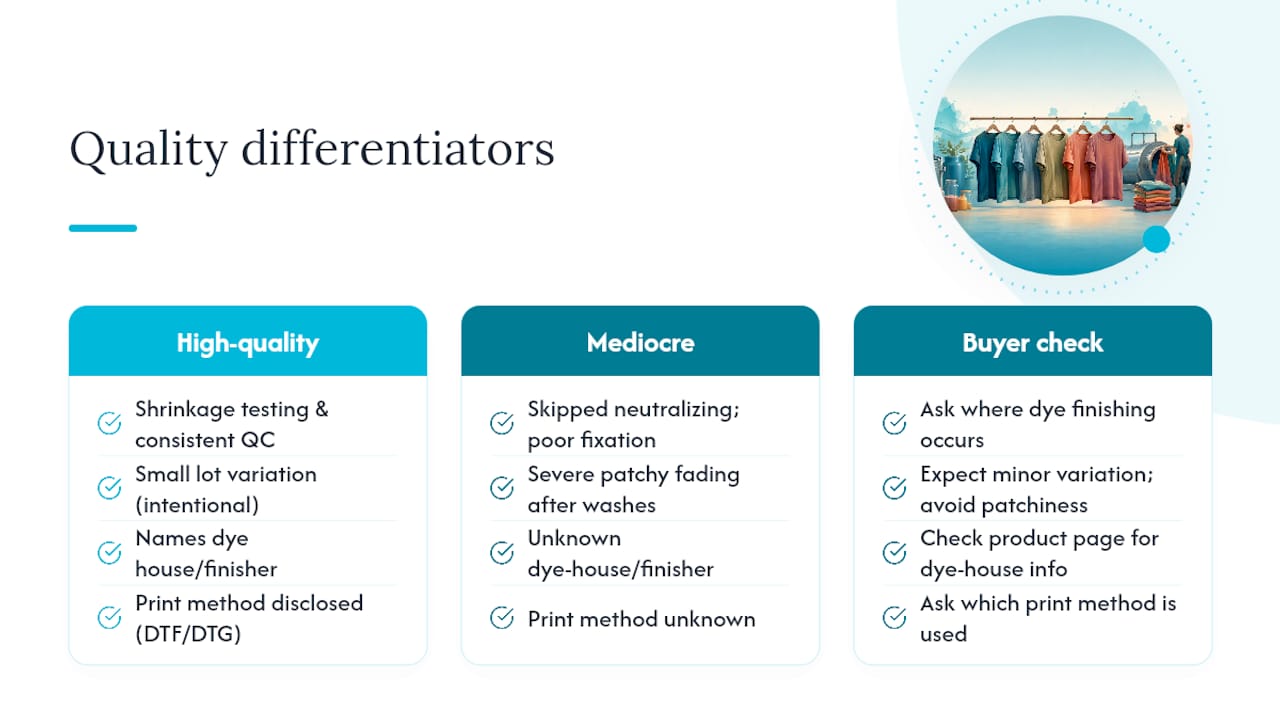
Production controls are the real differentiator. Shrinkage testing before and after the dye bath, consistent dye-house QC, and dye-compatible trims all separate a well-made piece from one that looks good in photos but fades unevenly after three washes.
Small color variation between pieces in the same dye lot is normal and often intentional — it’s part of what makes garment-dyed clothing feel artisanal. Severe, patchy fading after a few washes is a different story: that signals poor dye fixation or a dye house that skipped the neutralizing step. Industry editors at MR PORTER describe garment dyeing as a ‘risky art’ precisely because different fibers and trims react unpredictably in the same dye bath.
Brands that list their dye house or finishing origin, per Maker’s Row, tend to offer more consistent results and lower minimums because they control the QC directly. Ask customer service where the dye finishing happens if the product page doesn’t say. If they can’t answer, that’s information too.
For shoppers who also want printed graphics on their garment-dyed tee, the print method matters. DTF vs. DTG printing behave differently on pre-washed cotton, so it’s worth understanding which method a brand uses before ordering a custom design.
Why garment dyeing deserves more credit than it gets
Most shoppers treat the dye method as a style detail. It’s actually a production philosophy. Garment dyeing means a brand committed to a slower, more variable process because the result, that lived-in softness and tonal depth, can’t be replicated by washing a piece-dyed blank a few extra times. The color variation isn’t a compromise. It’s the point.
What gets overlooked is the sizing stability argument. Because the high-heat dye wash acts as a pre-shrink, a well-made garment-dyed tee often fits more predictably over time than a standard tee that hasn’t been pre-treated. That’s a practical benefit most product pages don’t mention.
The one honest caveat: if you need exact color matching across a large order, garment dyeing will frustrate you. Dye lots vary. For a uniform team uniform or a brand drop where every piece must look identical, piece dyeing is the more reliable choice. But for a tee you’re buying to wear, not to match, the variation is a feature.
Garment-dyed tees at Imuskop: what you get and how to order
Free shipping applies to every U.S. order, and interest-free payment plans through Affirm are available at checkout for shoppers who prefer to split the cost. U.S. fulfillment means orders ship quickly, and the return policy covers fit issues so there’s no risk on a first purchase.
Browse the full collection and check current colorways at the Imuskop storefront. Size charts, fabric specs, and product photography showing seam and collar detail are all on the product pages, so you can apply the checklist above before you buy.
Sources
- What Is Garment Dyeing? Guide For Brand Owners (2026) — Maker’s Row
- A guide to garment dyeing and why you should invest in it — MR PORTER (The Journal)
- What is Garment Dye? - Garment Dyeing Process | Levi’s blog (Off The Cuff)
- Garment Dyeing vs Piece Dyeing: Pros, Cons & When to Use Each — White Cotton
- What is garment dyeing — Moss (Inside Pocket)