

The best protest outfit ideas start with fitted, layered clothing in dark or neutral tones, closed-toe shoes, and a compact hands-free bag. Add removable symbolic accents like a pin or graphic tee if you want to make a statement. This combination keeps you mobile, protects your skin, and makes it harder for surveillance cameras or facial recognition tools to pick you out of a crowd.
TL;DR:
- Wearing fitted, layered clothing in dark or neutral colors helps you stay mobile and less detectable to surveillance tools during protests.
- Moisture-wicking fabrics and weatherproof outer layers are essential for comfort, especially for long marches or unpredictable weather conditions.
- Packing a small, lightweight protest bag with water, snacks, a mask, goggles, and emergency essentials supports safety without hindering movement.
- Digital privacy measures like masks or bandanas can obscure facial recognition, and turning off biometric unlocks protects your device if confiscated.
- Dressing in removable, symbolic accessories and checking local protest guidelines helps ensure safety, compliance, and the ability to blend in if needed.
Table of Contents
- Protest Outfit Ideas You Can Copy Today
- Fabrics, Gear, and Digital Privacy: The Safety Logic Behind the Outfit
- What to Pack (and What to Leave in the Drawer)
- Dressing for Heat, Cold, Rain, and All-Day Marches
- Symbolic Accessories and DIY Statement Pieces That Stay Safe
- Following Dress Codes and Local Protest Guidelines
- Cultural Sensitivity When Choosing Protest Attire
- Why Streetwear and Protest Gear Aren’t Actually Different Categories
- Editorial Picks: Muskop Pieces Built for the Street and the Rally
- Where This Guidance Comes From
- Sources
- FAQ
Protest Outfit Ideas You Can Copy Today
You don’t need to buy anything special to dress smart for a demonstration, but having a few go-to looks saves you from scrambling the morning of. Here are outfit combinations that work across most peaceful protest settings.
- The all-black low-profile look. Black leggings or jeans, a black long-sleeve top, and a black hoodie. This is the classic choice for larger marches where blending in matters, though it’s worth checking with local organizers first since wearing all black can sometimes draw more attention rather than less depending on the city and the cause.
- The streetwear combo. A bold graphic tee layered under an oversized hoodie with joggers and sneakers. This is where a piece from activist clothing brands does double duty: comfortable enough for hours on your feet, expressive enough to carry your message without a sign.
- The weatherproof commuter outfit. A moisture-wicking base layer, a packable windbreaker, and slim pants that won’t snag or flap. Good for unpredictable spring or fall days when you’re walking several miles between transit and the rally point.
- The protective-ready outfit. Long sleeves, long pants, closed-toe shoes, and goggles pushed up on your forehead, ready to pull down. Reserve this for demonstrations where tension is possible or history suggests police may use crowd-control chemicals.
- The comfort marcher. Broken-in sneakers or hiking shoes, cushioned wool or synthetic-blend socks, and a blister patch already applied to hot spots before you leave the house. Small gear choices like insoles and blister prevention noticeably extend how long you can stand or march without your feet becoming the reason you leave early.
- The coordinated-symbolic outfit. A shared color, like everyone in green or everyone in white, paired with a removable badge or button. This works well for organized groups who want a visual identity without individual signage.
Every one of these looks can flex up or down depending on the cause, the weather, and how long you expect to be on your feet.
Fabrics, Gear, and Digital Privacy: The Safety Logic Behind the Outfit
Fitted clothing isn’t just a style choice. Loose fabric can get grabbed, snagged on barriers, or caught in a crowd surge, and dark or neutral colors make it harder for cameras to track you across a sea of people. Experts recommend prioritizing function over fashion, which means moisture-wicking layers and a windbreaker beat a cute cotton jacket every time.
- Choose moisture-wicking synthetics or nylon outer layers over cotton, which holds moisture and irritants against skin.
- Skip oily lotions or heavy sunscreen. Oily products can trap chemical irritants against the skin if tear gas or pepper spray is deployed nearby.
- Wear glasses instead of contact lenses. Contacts can trap irritants against your eyes, making rinsing far more painful.
- Bring goggles and consider ear protection. ACLU-WA’s protest safety guidance specifically recommends both for irritants and loud crowd-control devices.
- A damp bandana or basic mask covers your nose and mouth and doubles as a privacy tool.
On the digital side, masks and bandanas can obscure your identity from facial recognition systems, a real concern given how widely such tools have been used to identify demonstrators after the fact. Turn off Face ID and fingerprint unlock before you leave, or better yet, leave your phone in airplane mode or at home entirely.
Pro Tip: Write two emergency contact numbers in permanent marker on your forearm or ankle before you leave. If your phone dies, gets confiscated, or you’re separated from your group, that ink doesn’t need a battery.
What to Pack (and What to Leave in the Drawer)
A protest bag should be small enough to keep your hands free and light enough that you forget it’s there after an hour of marching.
- Water and a few shelf-stable snacks
- A spare mask and a pair of goggles
- A small first-aid kit with bandages, saline solution, and any personal medication
- Cash (card readers can go down, and cash doesn’t leave a data trail)
- Photo ID, unless local legal guidance for the specific event suggests otherwise
- A portable power bank
- Emergency contact info written on paper, not just saved digitally
Gear guides consistently point to a compact, durable bag over a bulky backpack that bounces or a purse with a long strap someone could grab. A crossbody bag or a hip pack usually wins over a full backpack for anything shorter than an all-day event.
Leave jewelry, watches, and anything with sentimental or resale value at home. Civil-liberties guidance is blunt about this: valuables get lost in crowds, confiscated, or simply become one more thing to worry about protecting instead of focusing on the demonstration itself.
Dressing for Heat, Cold, Rain, and All-Day Marches
Hot weather calls for breathable, light-colored layers, but if you’re weighing visibility against sun protection, a light long-sleeve technical shirt beats a dark tank top for both comfort and skin coverage. Bring more water than you think you’ll need.
Cold or wet conditions call for a waterproof outer shell over insulating layers you can shed as the day warms up. Insulated insoles matter more than people expect. Standing on cold concrete for hours drains your energy faster than the air temperature alone would suggest.
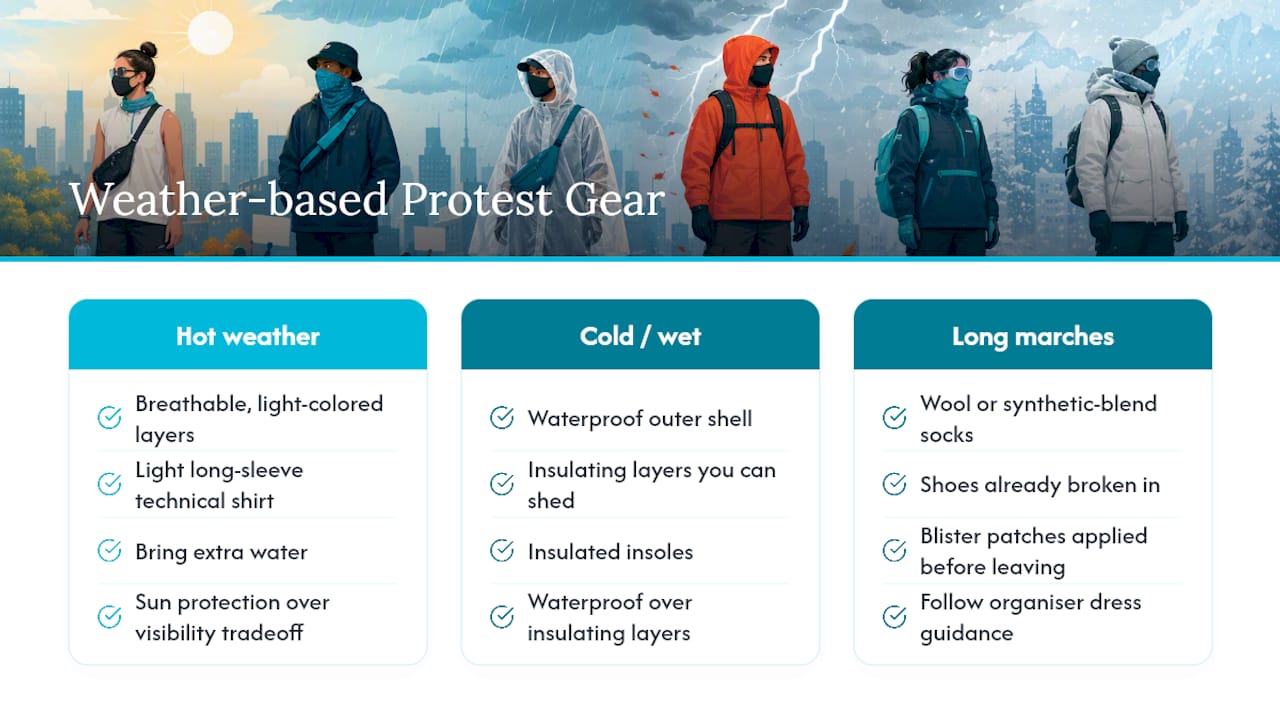
For marches that stretch across several miles or several hours, foot care decides how the day ends for you. Wool or synthetic-blend socks, shoes you’ve already broken in, and blister patches applied before you leave beat any pair of “cute but new” sneakers. If organizers have published specific guidance for the event, dress guidance included, follow it. Coordinated demonstrations often have a reason behind the color or dress code they request.
Symbolic Accessories and DIY Statement Pieces That Stay Safe
Messaging doesn’t require anything permanent or heavy. Pins, Velcro patches, and adhesive labels let you make a visible statement while keeping the option to remove it in seconds if the situation changes.
- Stick to lightweight, soft-sided signs; skip large rigid poles that can become safety hazards in a crowd or get confiscated at entry points.
- Choose props with no sharp edges or hard handles.
- If you’re wearing a costume element for a themed rally, pick something quick to shed, like a sash or a cape, rather than a full costume that restricts movement.
- Balance visibility with anonymity: a bold graphic tee says plenty without requiring your face to be the focal point.
Removable expression is the safest way to combine a message with the option to blend in fast if a peaceful demonstration takes an unexpected turn.
Following Dress Codes and Local Protest Guidelines
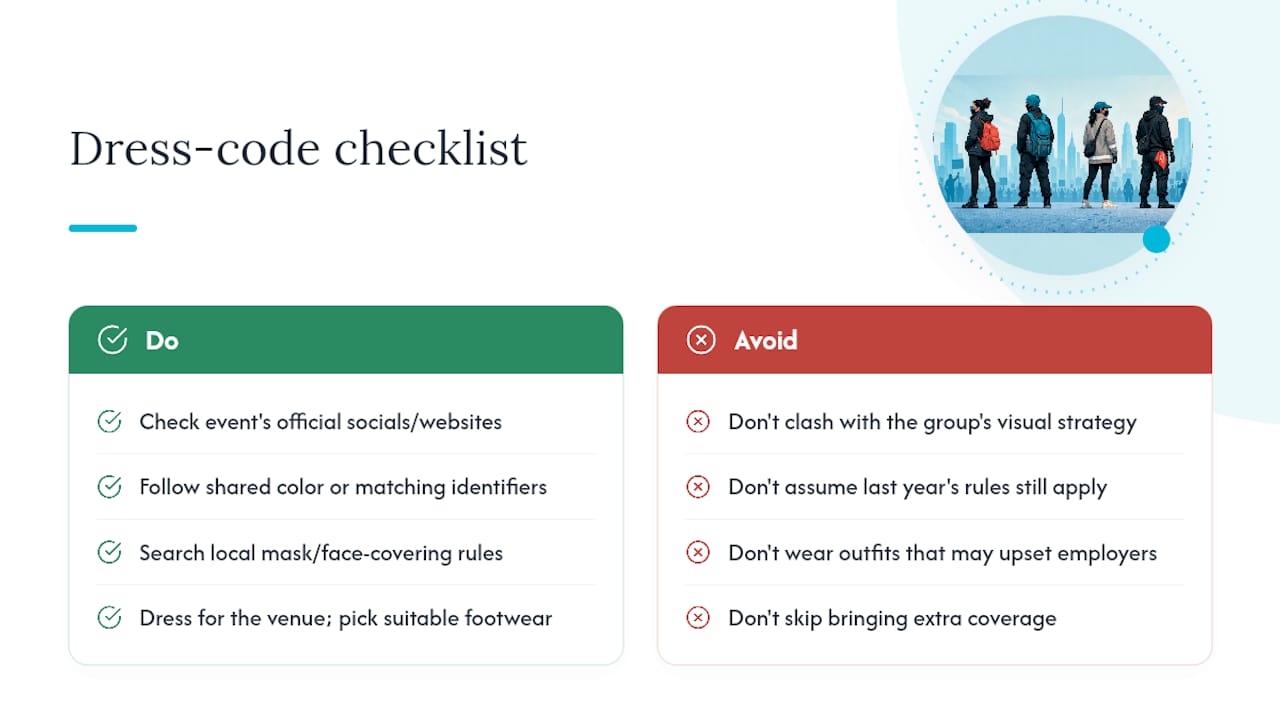
Organizers frequently issue specific dress instructions ahead of coordinated demonstrations. A shared color theme signals unity to media and other attendees, and matching identifiers can help marshals spot each other in a crowd. Checking an event’s official social media or website before you get dressed takes five minutes and prevents you from accidentally clashing with the group’s visual strategy.
Some cities also have local ordinances around masks or face coverings that shift depending on the political moment, so it’s worth a quick search for your specific city and date rather than assuming last year’s rules still apply. If an event has a permit that specifies a route or an assembly point, dress for that environment specifically. Downtown pavement calls for different footwear than a park lawn.
If you’re attending a workplace-adjacent rally or a march tied to a professional association, err toward more conservative styling. A graphic tee under a blazer or a neutral jacket lets you participate without creating friction with an employer’s expectations. When in doubt, layer. You can always remove a hoodie to reveal a statement shirt underneath, but you can’t easily add coverage you didn’t bring.
Cultural Sensitivity When Choosing Protest Attire
Borrowing imagery, language, or dress associated with a movement you’re not part of can undercut the message you’re trying to support. If you’re attending a march for a cause tied to a specific community, take your styling cues from what that community’s own organizers are wearing and requesting, rather than improvising symbols that might carry meaning you’re not fully aware of.
This matters most with religious or cultural garments, historic protest symbols, and language on signs or shirts. A phrase that reads as solidarity in one context can read as appropriation in another, depending on who’s wearing it and why. The safest approach is to show up in solid, unbranded pieces unless you’ve been specifically invited to wear something more particular, and to let your presence and your listening do more work than your wardrobe.
Dressing respectfully also means paying attention to modesty norms if the protest is organized by or centered on a specific faith community. A little research into the organizing group’s own guidance goes further than guessing.
Why Streetwear and Protest Gear Aren’t Actually Different Categories
Robert has spent years watching activist fashion get dismissed as either “too political” for everyday wear or “too soft” for real protest use, and both takes miss the point. Designing pieces with activist clothing brands in mind means thinking about fit, fabric weight, and how fast a message can come off if the moment calls for it. Good protest apparel should survive a long march and still say something worth reading.
— Robert
Editorial Picks: Muskop Pieces Built for the Street and the Rally
Some brands design graphic tees and streetwear with priorities like a real fit, fabric that holds up over a long day outdoors, and artwork you can pair with a plain hoodie when you’d rather stay lower profile. A statement tee under a neutral zip-up gives you the option to show your message or cover it in seconds, which matters more at a protest than at a concert.

Look for relaxed-fit joggers and hoodies when you’re layering for weather, and reach for a bold graphic tee when the goal is visibility over anonymity. If you’re building a warm-weather layer, an option like the eco-friendly zip hoodie built for festival wear pairs well over one of Imuskop’s tees for exactly this kind of on-and-off flexibility. Browse the full Imuskop collection to build out a few outfit options before your next demonstration, and check sizing early since fitted layers work best when they actually fit.
Where This Guidance Comes From
- WIRED’s protest safety and gear guide for packing and preparation
- HuffPost’s protesting safety guide and CAIR’s Know Your Rights guide for practical safety steps
- Academic coverage of facial recognition abuse for surveillance context
Sources
- Protesting tips: What to bring, how to act, how to stay safe (WIRED)
- The abuse of facial recognition technology in the Hong Kong protests (2025)
- Know your rights guide to protesting & community safety (CAIR)
- The 3.5% rule and how a small minority can change the world (Harvard Kennedy School)
FAQ
What is the 3.5% rule for protests?
The 3.5% rule, documented by researchers at Harvard Kennedy School, suggests that sustained nonviolent movements that mobilize about 3.5% of a population have historically achieved major political change. It underscores why showing up, and dressing to stay for the long haul, actually matters.
What should I wear to a protest?
Wear fitted, dark or neutral layers, closed-toe shoes, and clothing that covers your skin, with a compact bag holding water, a mask, and basic first-aid supplies. A graphic tee from a brand like Imuskop under a neutral hoodie gives you both expression and the option to blend in.
Why should I turn off Face ID during a protest?
Disabling Face ID and other biometric unlock features prevents anyone, including law enforcement, from forcing your phone open with your face if it’s confiscated. It’s a small step that protects your device and the contacts, photos, and messages on it.
What should I dress up as for an American-themed protest party?
Stick to simple, quickly removable pieces like a sash, a themed graphic tee, or a lightweight accessory rather than a bulky costume. Anything you can shed fast if plans change is safer than a full costume that limits your mobility.