

White, gray, navy, black, and cream cover the most outfits with the least effort, but each comes with its own price. White brightens every look and pairs with almost anything, though it demands the most upkeep. Gray and navy hide dirt and scuffs, so they stay presentable longer between cleanings. If you want one pair that works for the majority of your wardrobe, skip straight to the Personal Style Guide for Women: Build Your Best Wardrobe for outfit-building formulas and a checklist.
TL;DR:
- White sneakers require regular cleaning to maintain versatility, especially since they stain and yellow more easily over time.
- Gray and navy sneakers hide dirt better and stay fresh longer, making them more practical options for everyday wear.
- Matching sneakers to accessories like hats and belts should be limited to one point of color coordination to avoid looking overly uniform.
- The effectiveness of sneaker colors depends on their material, with leather being easier to clean than suede or mesh, which stain faster.
- Lighting conditions significantly alter how sneaker colors appear, so always check colors under different lights before purchasing or pairing.
Table of Contents
- Which sneaker colors work with the most outfits?
- Practical styling formulas that make matching easy
- How to match sneakers with denim, chinos, and black pants
- How to style bold, pastel, neon, or multicolor sneakers
- How material affects your sneaker color choice
- First-pair checklist: picking one color that covers everything
- Muskop’s approach to matching tees and sneakers
- Matching sneaker color to your skin tone and undertones
- Coordinating sneaker color with belts, hats, and bags
- Sneaker colors for casual, business casual, and event dress codes
- Why lighting changes how sneaker colors actually look
- A publisher’s note on keeping this practical
- Complete the look with the right tee
- Sources
Which sneaker colors work with the most outfits?
Sneaker color coordination gets a lot simpler once you accept that five colors do most of the heavy lifting: white, black, gray, navy, and cream. Each one earns its spot for a different reason, and none of them is free of trade-offs.
White is the default for good reason. It brightens dark outfits, plays well with blue denim, and reads clean against almost every summer palette. The catch: white leather shows dirt fast and can yellow with age, so it only stays “versatile” if you’re willing to clean it regularly.
Black goes the other direction. It hides scuffs, works for travel, and blends into darker fall and winter wardrobes without a fight. The downside shows up in warm weather, where black sneakers can look heavy against pale linen or light chinos.
Gray might be the most underrated of the bunch. It splits the difference between white and black, pairing easily with navy, denim, and charcoal without demanding much maintenance. Gray and navy often score higher than white for everyday practicality precisely because they hide dirt and hold their “fresh” look longer.
Navy and cream or gum-sole sneakers round things out. Navy softens sharper outfits and suits business-casual denim days. Cream and gum soles take the edge off a stark white shoe and lean into vintage or warm-toned wardrobes, which is why they show up so often in fall styling.
Quick outfit snapshots:
- Faded blue jeans, a plain gray tee, white low-tops.
- Charcoal chinos, a navy overshirt, gray runners.
- Black joggers, a graphic tee, cream trainers with gum soles.
- Olive pants, a rust-colored hoodie, off-white sneakers.
Practical styling formulas that make matching easy
You don’t need a color-theory degree to dress well. Three or four repeatable formulas cover almost every situation.
- The neutral sandwich. Keep your top and bottom in neutral tones (black, gray, beige, navy) and let one bold sneaker color be the entire statement. This is the safest formula for a first “loud” pair.
- The color echo. Pick one small element near your face, a hat, a tee graphic, sunglasses, and match it to your sneaker color. Micro-supporting a bright shoe color elsewhere in the outfit makes it look planned instead of accidental.
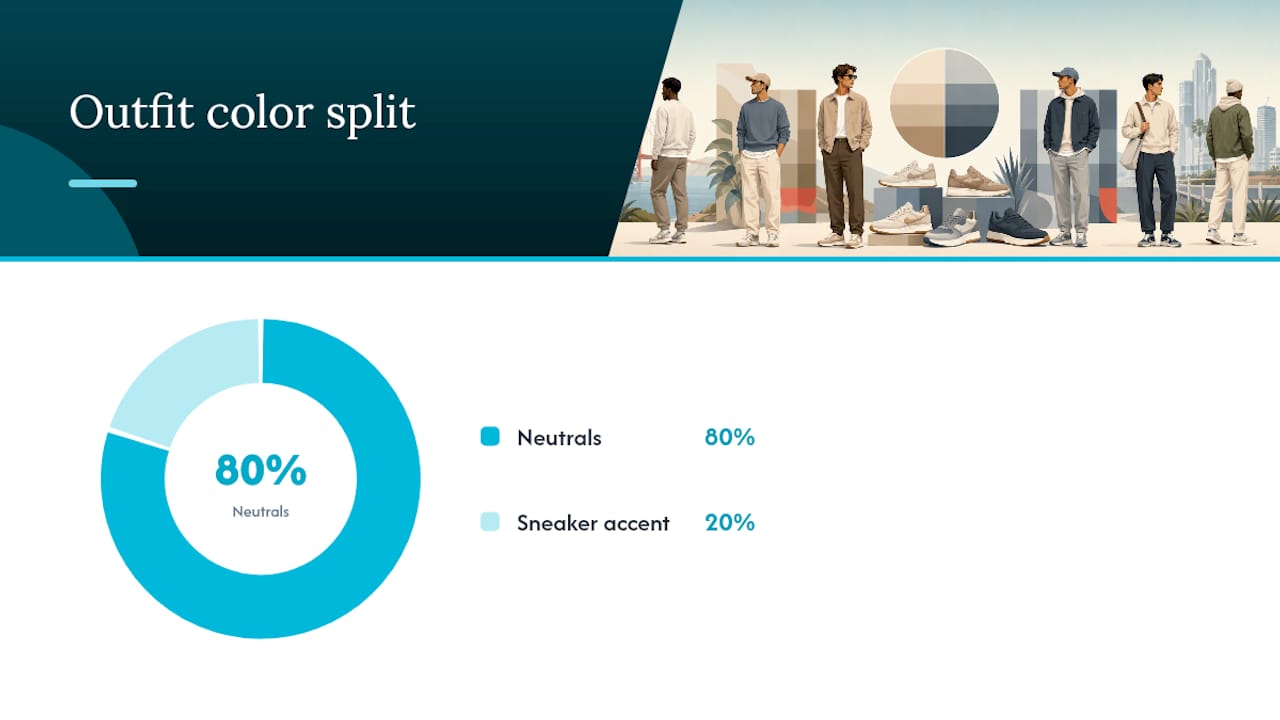
- The 80/20 rule. Let 80 percent of your outfit sit in one dominant neutral, and reserve 20 percent for your sneaker’s accent color. This keeps outfits from looking like a uniform while still feeling coordinated.
- Monochrome or tone-on-tone. Match your sneaker to the closest shade already in your outfit (navy shoes with navy pants, different textures) for a clean, unified silhouette. This works particularly well in colder months when you’re layering similar tones anyway.
Color theory backs this up: analogous and complementary combinations create harmony, while over-matching everything to the exact same shade usually looks flat.
Pro Tip: Once you’ve mastered these formulas, break one on purpose. A clashing sneaker color against an otherwise neutral outfit is a classic streetwear move, and it only works because you clearly know the rule you’re bending.
How to match sneakers with denim, chinos, and black pants
Different wardrobe staples call for different sneaker logic, and this is where most people either nail it or overthink it.
- Denim: White, navy, gray, and cream sneakers all work because indigo is a neutral in disguise. White adds contrast, navy blends in for a monochrome effect, and cream softens a heavily faded pair of jeans.
- Chinos and khakis: Warmer neutrals do more work here. Cream, tan, and gum-sole sneakers complement the earthy tone of khaki better than stark white, which can look almost too clinical against warm cotton.
- Black pants or all-black outfits: Stick with black-and-white combinations or darker sneakers. A bright white sneaker under all-black clothing draws too much attention to your feet and throws off the visual balance.
- Smart-casual or office-adjacent looks: Clean white or gray leather runners, or a muted suede sneaker, read as intentional rather than sporty. Avoid anything with visible foam soles or loud branding for these settings.
- Athleisure: This is the one category where brighter or metallic sneakers get a pass. Ground a bold colorway with a solid-color hoodie or joggers so the shoe doesn’t compete with a busy print above it.
Matching sneaker silhouette and color to the context you’re dressing for matters as much as the color itself. A chunky trail-style sneaker in navy reads differently than a slim navy leather runner, even in the same shade.
How to style bold, pastel, neon, or multicolor sneakers
Statement sneakers scare people off because they assume every color on the shoe needs a matching piece in the outfit. That’s backward. Start by identifying the one or two dominant colors on the shoe, ignore the rest, and build around those.
- Pick a single dominant hue from the sneaker and echo it once, in a hat, a tee graphic, or a bag strap.
- Let neutrals (black, white, gray, olive) carry the rest of the outfit as a backdrop.
- Use analogous colors (blue and green, orange and yellow) for a softer pairing, or complementary colors (orange sneaker, navy outfit) for more contrast and energy.
- Save pastels for spring and summer outfits with lighter fabrics, and reserve neon for gym or athleisure contexts where it feels purposeful rather than random.
Identifying the underlying palette of a multicolor sneaker before you build an outfit around it is the difference between a shoe that looks curated and one that looks chaotic. A sneaker with orange, gray, and white detailing only needs the gray and white acknowledged elsewhere. The orange can stand alone as the accent.
How material affects your sneaker color choice
Color and material aren’t separate decisions. The same white can behave completely differently depending on what it’s made of.
- White leather cleans up easily with a damp cloth and mild soap, making it the more practical version of white for daily wear.
- White suede or mesh looks great fresh out of the box but stains faster and is harder to spot-clean, so it suits drier climates and lighter use better than daily rotation.
- Suede and nubuck in any color read richer and more premium, but they need brushing and a protectant spray to avoid water spots.
- Mesh and knit uppers shift in perceived color under different light and wear casually, but they’re less forgiving with mud or rain.
- Gum soles and off-white uppers hide the kind of yellowing that plagues bright white midsoles, which is part of why they’ve become a vintage-inspired staple.
Pro Tip: If you clean your sneakers only when they look visibly dirty rather than on a schedule, skip all-white mesh or pale suede entirely. Save white for leather, where a quick wipe actually restores the look.
First-pair checklist: picking one color that covers everything
If you only want one sneaker to handle 80 percent of your wardrobe, answer these questions first:
- How often will you actually clean your shoes? If the honest answer is “rarely,” skip white and go gray or navy instead. White only stays versatile when you’re committed to regular cleaning; otherwise it becomes your least-worn pair within a month.
- What colors dominate your closet? Mostly denim and neutrals point to white or cream. Mostly black and charcoal point to black or gray.
- What’s your climate like? Wet, muddy, or salty winters favor darker uppers and treated leather over suede or pale mesh.
- What’s the buy checklist? Leather over suede for easy cleaning, a low-profile silhouette for versatility across casual and smart-casual settings, and a neutral sole (white, gum, or gray) rather than a loud contrast color.
A neutral base with one small controlled contrast, a subtle black heel tab on a white shoe, for instance, tends to outperform heavy multicolor blocking as an everyday, do-it-all option.
Muskop’s approach to matching tees and sneakers
Imuskop built its catalog around graphic tees and streetwear, which means sneaker pairing is baked into how the designs get made. A neutral sneaker, white, gray, or navy, works as the quiet partner to a bold graphic tee, letting the print do the talking while the shoe echoes one small color from the design.
For deeper outfit-level examples, Imuskop’s guides on what sneakers should match with your outfit and matching sneakers with shirts walk through specific combinations step by step.
Matching sneaker color to your skin tone and undertones
Sneaker color and skin undertone work the same way jewelry gold versus silver does: it’s about what makes your complexion look brighter, not about avoiding certain shades altogether. If you have warmer undertones (gold or peachy hints under the skin), cream, tan, gum-sole, and warm-toned sneakers tend to feel more harmonious than stark, cool white. If you lean cooler (pink or blue undertones), true white, navy, and black read cleaner and more flattering against your skin.
This mostly matters when the sneaker sits close to bare skin, think ankle-length pants or shorts with no socks showing, since that’s when the color contrast with your leg or foot skin is most visible. With full-length pants covering the ankle, the effect is minor.
Neutral undertones have the easiest time here, since most sneaker colors will look fine. If you’re not sure which category you fall into, check the veins on your wrist in natural light: greenish veins usually mean warm undertones, bluish veins mean cool, and a mix of both usually means neutral. When in doubt, color coordination guidance built around undertones recommends testing a shoe against your skin in daylight before committing to it as a wardrobe staple, since store lighting can distort how warm or cool a color actually reads.
Coordinating sneaker color with belts, hats, and bags
Accessories are where a sneaker color either gets tied together or left looking like an afterthought. The easiest rule: pick one accessory to echo your sneaker color, not all of them.
A brown leather belt pairs naturally with cream, tan, or gum-sole sneakers, while a black belt matches better with black or white sneakers that have dark accents. Bags follow similar logic. A canvas tote or crossbody in olive or navy complements gray and navy sneakers, while a black backpack keeps things simple against nearly any sneaker color.
Hats do the most visible work since they sit near your face, which is exactly why the color echo formula leans on them so often. If your sneakers have even a small patch of red, yellow, or blue, a cap in that same shade pulls the whole outfit together without requiring a matching jacket or pants.
The mistake to avoid: matching every accessory to your sneaker at once. A navy sneaker, navy belt, navy hat, and navy bag together starts to look like a costume rather than an outfit. Pick one, maybe two, points of connection and let the rest of your accessories stay neutral, black, brown, or gray, so the sneaker color still reads as the intentional focal point.
Sneaker colors for casual, business casual, and event dress codes
Context changes what “versatile” even means. A sneaker color that works for a weekend errand run can look out of place at a dressier event, and vice versa.
For casual settings, the whole point of this article applies without much restriction: white, gray, navy, cream, and even bold colorways all have a place, especially paired with denim or joggers.
Business casual narrows things considerably. Clean white or gray leather runners with minimal branding read as put-together, while suede sneakers in muted tones like navy or olive can work in more relaxed office environments. Chunky sole units, neon accents, and visible logos tend to clash with tailored pants or blazers, so save those for outside work hours.
Events depend heavily on the dress code stated, but a general rule holds: the more formal the occasion, the more the sneaker should look like a shoe first and a sneaker second. A sleek white or black leather low-top with minimal detailing can pass at a semi-formal event where a chunky trail runner or a neon mesh sneaker would not. When the invitation says “smart casual,” a clean navy or gray sneaker paired with tailored chinos usually threads the needle between comfortable and put-together.
Why lighting changes how sneaker colors actually look
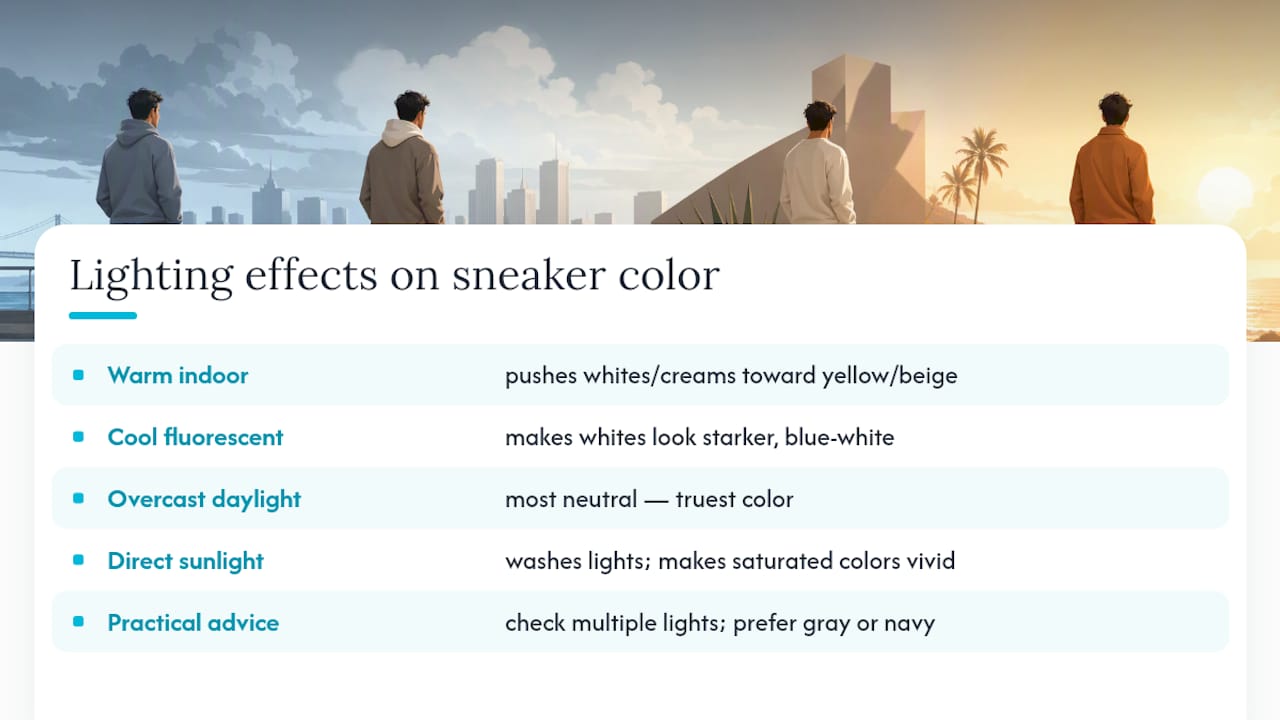
The white sneaker you bought under store fluorescents can look distinctly different once you’re standing outside in daylight, and that’s not your imagination. Warm indoor lighting (the yellowish glow from incandescent or warm LED bulbs) pushes whites and creams toward a yellow or beige tint, while cool fluorescent lighting, common in retail stores, can make the same shoe look starker and more blue-white than it does at home.
Overcast daylight tends to be the most neutral, “true” light for judging color, which is why photographers and stylists often prefer it for product shots. Direct sunlight, by contrast, can wash out lighter colors while making saturated colors, reds, blues, and bright multicolor sneakers, look more vivid and intense than they do indoors.
This matters practically in two ways. First, if you’re buying sneakers online or in a store, try to check the color in more than one lighting environment before committing, especially with whites, creams, and grays that shift the most. Second, when you’re building an outfit, remember that a sneaker color that reads as a clean match at home under warm lighting might look slightly off once you’re outside under midday sun. When in doubt, neutral tones like gray and navy are the most forgiving across different lighting conditions, since they don’t swing as dramatically toward yellow or blue the way white and cream can.
A publisher’s note on keeping this practical
The goal with sneaker color coordination has never been to overthink it. Imuskop’s approach to styling starts from the same place this article does: pick a neutral that fits your life, learn two or three formulas, and stop treating every outfit like a puzzle. If you want more outfit-level pairings built around graphic tees, Imuskop’s sneaker and tee matching guides are a good next stop.
— Robert
Complete the look with the right tee
A neutral sneaker does most of the outfit work, but the tee above it decides whether the look feels finished or just fine. Imuskop’s graphic tees are built for exactly this kind of pairing: bold pop-culture and activism-driven artwork that gives your sneaker color something to echo, whether that’s a color-blocked print picking up your gum soles or a stark black-and-white graphic that plays off a clean white low-top.

If you’re working the neutral sandwich formula from earlier, a Imuskop tee is the easy way to add personality without breaking the outfit’s balance. Pair a graphic tee in a muted tone with gray or navy sneakers for an everyday look, or let a louder design be the statement while your sneakers stay neutral and quiet. Shipping and payment options vary; see the website for current details. Browse the full tee collection and find the print that matches the sneakers you already reach for.
Sources
- What Color Sneakers Go With Everything? – Rarefoot
- How To Style Multicolor Sneakers: Your Ultimate Guide
- Color coordination pairing sneakers with your wardrobe - Cushiow
- What to Wear with Bright Sneakers: A Style Guide — MioLook
- Rules for matching your sneakers to your outfit — Complex