

A quality T-shirt comes down to three things: the fiber and yarn, the fabric weight, and the construction. Check the collar for snap-back, look for double-needle hems, and hold the fabric up to light. If it passes those three quick tests, it’s built to last more than a few washes.
TL;DR:
- A T-shirt’s durability mainly depends on fabric weight, yarn quality, construction, and stitching, with midweight cotton (180-220 GSM) being ideal for everyday wear.
- Ring-spun and combed cotton indicate higher quality and longevity, while open-end cotton is cheaper and pills faster, affecting the shirt’s lifespan.
- Look for double-needle stitching, flatlock seams, and shoulder tape as signs of solid construction that prevent unraveling and shape loss over time.
- Proper fit measurements, especially shoulder seam placement and chest width, are critical, as a high-quality fabric cannot compensate for poor sizing.
- Brands with transparent manufacturing practices, good return policies, and consistent review feedback are more reliable for buying durable and well-made T-shirts.
Table of Contents
- The 7 quality markers every buyer should check
- Red flags: what to avoid when buying
- How to evaluate a T-shirt online before you buy
- Why fit matters as much as fabric
- Cotton, tri-blends, and polyester: picking the right fabric
- Care, shrinkage, and how long a T-shirt should actually last
- Why trust this guide: technical resources behind the checklist
- Ethical and sustainable manufacturing as a quality signal
- What brand reputation and return policies tell you
- Build a small rotation instead of a big pile of cheap tees
- Shop Imuskop tees built on these same specs
- Sources
The 7 quality markers every buyer should check
Most people judge a T-shirt by how it feels folded on a table. That’s backwards. The specs that actually predict how a shirt performs after twenty washes are printed on the tag or buried in a product description you have to dig for. Here’s what to look at, in the order that matters most.
1. Fabric weight (GSM or ounces). GSM stands for grams per square meter, and it’s the single best predictor of how a shirt will drape, hold its shape, and survive the dryer. Shirts in the lightweight range are closer to a summer undershirt than a standalone tee. They breathe well but show wear fast and can turn see-through after a few washes. The 180 to 220 GSM band is where most well-made everyday tees land, thick enough to stay opaque without feeling like a sweatshirt, and buyer guides consistently point to midweight cotton around 6 ounces as the practical sweet spot for durability and structure. Heavier fabrics are often considered premium or heavyweight streetwear; they hold up well but drape stiffer and run warmer, which matters if you’re buying for summer.
2. Yarn and fiber quality. Not all cotton is spun the same way, and the spinning method changes everything about how long a shirt lasts. Open-end spinning is the cheapest process. It twists shorter, looser fibers into yarn, which produces a rougher, weaker thread that pills quickly. Ring-spun cotton twists and thins the fibers further, creating a smoother, stronger yarn. Combed ring-spun goes one step further by removing the short fibers entirely before spinning, and industry guidance consistently favors combed ring-spun cotton over open-end yarn as the clearest fiber-quality signal on a tag. Supima and other long-staple cottons take this further still, using extra-long fibers that resist pilling for years rather than months. If a listing doesn’t mention the spinning method at all, assume it’s the cheaper open-end stock.
3. Knit construction. Single jersey knit is standard and lightweight, common in budget tees. Interlock knits use two sets of needles to create a denser, more stable fabric that resists curling at the edges. Loopwheel knitting is the rarest and most expensive method, producing fabric with almost no tension, which means less shrinkage and a noticeably softer hand. You’ll rarely find loopwheel construction below a certain price point because the machines run slower and the mills that still use them are limited in number.
4. Stitching and seam construction. Flip the shirt inside out and look at the hems. Double-needle stitching, two parallel rows of thread at the sleeve and bottom hem, resists unraveling far better than a single stitch line. Stitches per inch (SPI) is the technical measure, but you don’t need a ruler to spot the difference: tight, even, closely spaced stitches signal quality, while loose, uneven, widely spaced ones signal a rush job. Flatlock seams and shoulder tape are higher-end construction details that reduce chafing and keep the neckline from stretching out of shape over time. Shoulder tape specifically is a thin strip of fabric sewn into the shoulder seam that stops the shirt from sagging at the shoulders after repeated wear.
5. Collar reinforcement. The collar is usually the first thing to go on a cheap tee. Ribbed collars with good elastic recovery snap back to shape after you stretch them; loose or bound collars stay stretched out, giving the shirt that tired, secondhand look within a month. Self-fabric collars (made from the same jersey as the body) tend to be softer but less durable than a dedicated ribbed collar.
6. The twist and light test. In person, grab a section of fabric and twist it firmly. Cheap, loosely spun cotton distorts and shows visible gaps between yarns. Quality cotton holds its structure. Then hold the shirt up to a light source. If you can see your hand clearly through the fabric at 180+ GSM, something is off. Hand tests like these correlate reliably with long-term performance and take about ten seconds each.
7. Dyeing and finish. Garment-dyed shirts are dyed after the garment is fully constructed, which produces a slightly softer, more lived-in look but can mean more variation between batches. Yarn-dyed shirts are dyed before knitting, which typically produces more consistent, longer-lasting color. Neither is objectively “better,” but knowing which one you’re buying helps set the right expectations for how the color will hold up over time.
Pro Tip: Carry a $5 fabric shirt you already own as a benchmark. Twist it, hold it to light, and check its GSM if you know it. Comparing a new listing against a shirt you’ve already lived in for a year is more reliable than trusting any single number on a page.
Red flags: what to avoid when buying
Some listings tell you exactly what you’re getting. Others are designed to keep you from asking. Here’s the pattern to watch for before you add anything to a cart.
- No spec sheet or measurements. If a product page lists only “S, M, L, XL” with no chest width, length, or GSM, that’s not an oversight. Brands confident in their fabric usually publish it.
- Marketing words standing in for specs. “Premium,” “luxury,” and “elevated” mean nothing without a number attached. A shirt described only in adjectives, with zero mention of yarn type or weight, is hiding something.
- Sizing complaints in the reviews. If multiple reviewers say the shirt runs a full size small or large, that’s a manufacturing consistency problem, not a one-off.
- Visual tells in the product photos. Translucent fabric under studio lighting, a floppy collar in the flat-lay shot, or visibly uneven hemlines are all things a brand can’t fully hide even in a staged photo.
- No clear return or wash policy. A brand that won’t commit to a return window or give any washing guidance is often one that knows the shirt won’t hold up to either.
How to evaluate a T-shirt online before you buy
You can’t twist-test a shirt through a screen, but you can build a routine that catches most of what matters before checkout.
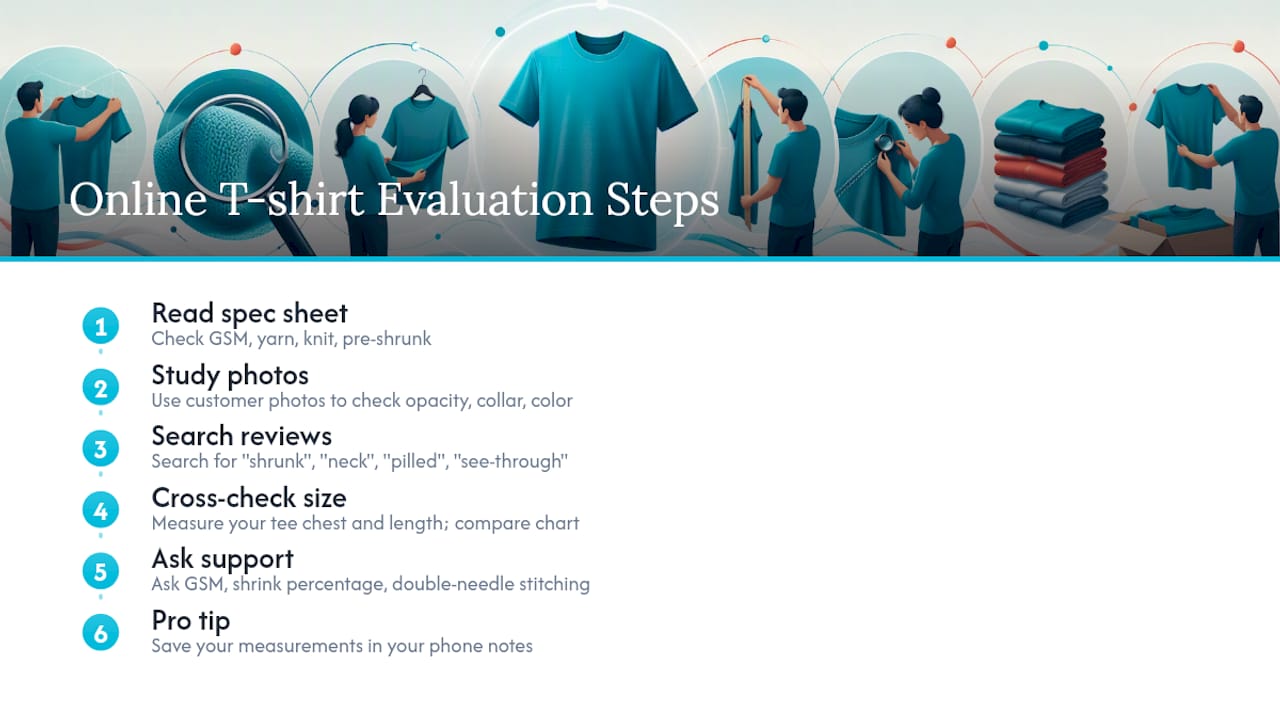
Step 1: Read the spec sheet like a label. Look specifically for GSM, yarn type (ring-spun, combed, open-end), knit style, and whether the shirt is labeled pre-shrunk. Objective specs like these are what separate a serious listing from a vague one, and a brand willing to publish them is usually willing to stand behind them.
Step 2: Study the photos, especially customer uploads. Brand photography is lit to flatter. Customer-uploaded images in the review section show the shirt under a bedroom lamp or bathroom mirror, which is a far more honest test of opacity, collar shape, and true color.
Step 3: Search the reviews for specific words. Skip the star rating and search the review text for “shrunk,” “neck,” “pilled,” and “see-through.” A shirt with a handful of five-star reviews and three mentions of a stretched-out collar is telling you something the average rating won’t.
Step 4: Cross-check against a tee you already own. Lay your best-fitting shirt flat and measure chest width and length. Compare those numbers against the size chart on the new listing rather than trusting the size label alone. Different brands cut a “medium” very differently.
Step 5: Ask support the questions that actually matter. If none of that information is on the page, email or chat with support and ask directly: What’s the GSM? What percentage does it shrink after the first wash? Is it double-needle stitched? A brand that answers specifically is worth more trust than one that replies with “it’s great quality, you’ll love it.”
Pro Tip: Save your measurements from a well-fitting shirt in your phone’s notes app. Pull them up every time you shop online, so you’re comparing against your own body instead of guessing from a size chart.
Why fit matters as much as fabric
A shirt made from the best combed ring-spun cotton on the planet is still a bad purchase if it doesn’t fit. Fit and construction and fabric are not separate categories you weigh against each other. They’re a single test a shirt either passes or fails, and a technically premium fabric will underperform if the shirt is poorly assembled or poorly cut for your body.
Five measurements tell you almost everything before you buy:
- Shoulder seam placement. It should sit right at the edge of your shoulder, not sliding down your arm or riding up onto your neck.
- Chest width. Measure straight across the shirt one inch below the armpit, then double it. Compare against the brand’s size chart, not the generic S/M/L label.
- Sleeve length. Short sleeves should end somewhere on the upper arm; where exactly depends on style, but they shouldn’t flare out like a bell.
- Shirt length. Measure from the highest point of the shoulder to the hem. Too short and it rides up when you reach overhead; too long and it looks like a nightshirt.
- Neckline and neck drop. Crew necks should sit close to the base of your neck without choking or gaping.
Lay a tee you already trust flat on a table and take these five measurements yourself before you ever open a size chart. Vanity sizing is real. A “large” from one brand can match a “medium” from another, and the only way around that is comparing actual inches, not labels.
Cotton, tri-blends, and polyester: picking the right fabric
The right fabric depends entirely on what the shirt needs to do, not on which one sounds fanciest on a hangtag.
- 100% combed ring-spun cotton is the default for a reason. It takes screen printing and direct-to-garment ink cleanly, breathes well, and in the 180 to 220 GSM range holds its shape through regular washing. If you’re buying a graphic tee where the print needs to sit flat and vibrant, this is almost always the right call.
- Supima and other long-staple cottons cost more because the extra-long fibers resist pilling for years instead of months and develop a softer hand with age rather than a worn-out one. The premium is worth paying if you wear a shirt weekly rather than occasionally.
- Tri-blends (typically cotton, polyester, and rayon) trade some durability for a lighter, vintage-washed drape that shrinks less than pure cotton and dries faster. They’re a strong choice if you want that broken-in look on day one.
- Polyester and poly-cotton blends shine in athletic and performance contexts, where moisture-wicking and shape retention under sweat matter more than natural fiber softness. Fabric comparisons consistently note polyester’s edge in shrink resistance and quick drying, which is exactly why it dominates gym wear.
For a graphic tee meant to showcase art, combed cotton in the midweight range prints cleaner and lasts longer than anything blended with synthetic fiber. For an everyday layering piece you’ll wash constantly, a tri-blend earns its keep. For workouts, poly-blends win outright.
Care, shrinkage, and how long a T-shirt should actually last
“Pre-shrunk” doesn’t mean shrink-proof, and treating it that way is how good shirts end up two sizes too small. Pre-shrunk labeling typically means the fabric went through a controlled factory shrink process that limits post-purchase shrinkage to around 2 to 3 percent, compared to raw, untreated cotton that can shrink 5 to 8 percent on its very first hot wash.
Keep shirts closer to their original size and color with a few habits:
- Wash cold, always, and turn graphic tees inside out to protect the print from friction and fading.
- Skip the dryer’s high heat setting; low heat or a hang-dry line does far less damage to both fiber and print.
- Avoid bleach entirely, even on white tees, since it breaks down cotton fibers over time regardless of color.
- Following proper shrink-prevention steps from the first wash on matters more than anything you do later.
A budget tee washed carelessly might survive six months before the collar goes slack and the print cracks. A well-made midweight cotton tee, cared for properly, can hold its shape and color for two to three years of regular rotation before pilling or collar wear becomes noticeable.
Why trust this guide: technical resources behind the checklist
This checklist comes from breaking down exactly what separates a shirt that lasts from one that doesn’t, using the same measurable specs that manufacturers use internally. Robert, who covers apparel quality for Imuskop, put this guide together to give shoppers a way to evaluate any listing, not just Imuskop’s own.
For readers who want to go deeper on any single spec, a few resources dig into the mechanics further:
- How GSM actually determines a shirt’s weight and drape
- The full breakdown of combed cotton versus standard cotton
- What garment-dyeing does to color consistency over time
- The right way to wash a printed graphic tee without cracking the ink
Compare the spec sheet on any product page against this checklist before buying. If a listing doesn’t give you the numbers to check, that itself is useful information.
Ethical and sustainable manufacturing as a quality signal
Brands that invest in ethical production tend to invest in fabric quality too, and the two aren’t a coincidence. Manufacturing shortcuts that cut labor costs usually show up alongside shortcuts in yarn quality and stitching, because both come from the same pressure to hit a rock-bottom price point.
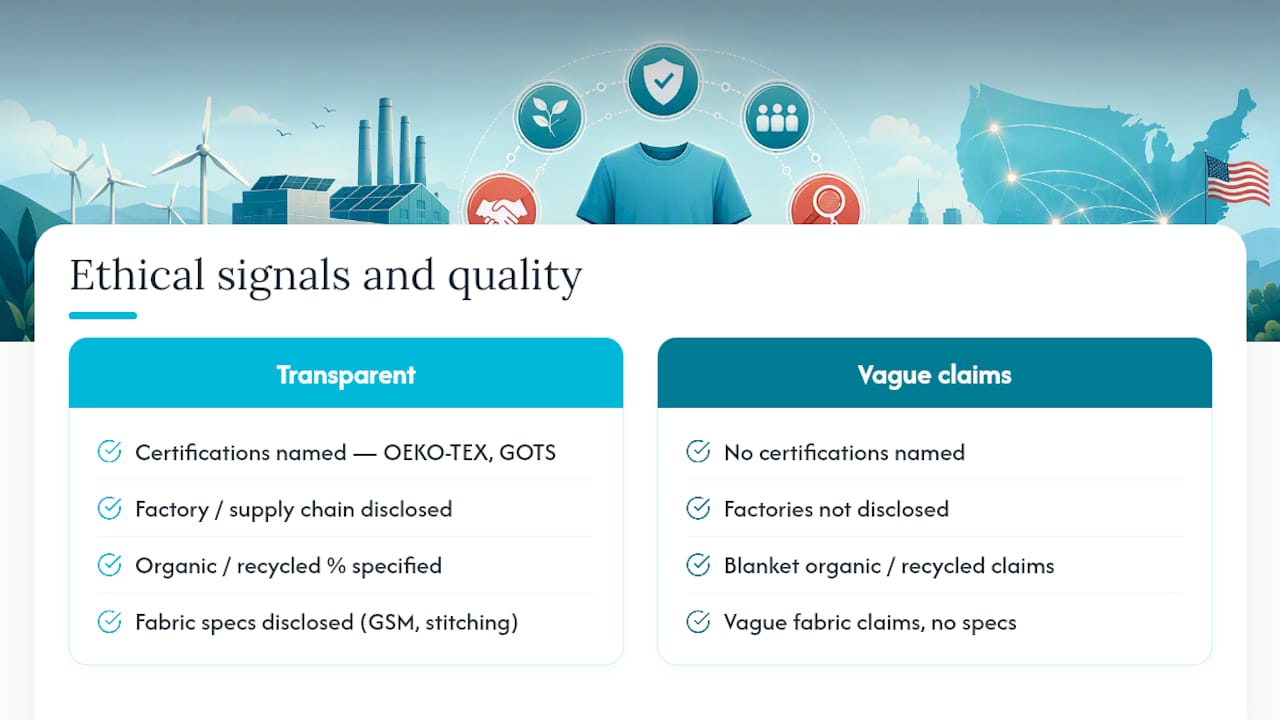
Look for a few concrete signals rather than vague sustainability language. Certifications like OEKO-TEX or GOTS (Global Organic Textile Standard) indicate the fabric was tested for harmful substances and, in GOTS’s case, produced under audited labor and environmental standards. A brand that names its factories or discloses its supply chain, even briefly, is taking on accountability that a brand hiding behind “ethically made” text alone is not. Organic or recycled cotton content, when specified with an actual percentage rather than a blanket claim, is another checkable detail rather than a marketing flourish.
None of this replaces checking GSM and stitching directly, but a brand transparent enough to disclose its manufacturing practices is statistically more likely to be transparent about its fabric specs too. Vague ethics claims paired with vague fabric claims on the same page are a pattern worth noticing.
What brand reputation and return policies tell you
A generous return policy isn’t just customer service. It’s a bet the company is making on its own product. A brand offering a 30 or 60-day return window, no questions asked, is confident enough in its shirts that it can absorb the occasional return without the math falling apart. A brand offering seven days and store credit only is hedging against a product it expects to disappoint people.
Warranty language works the same way. Few T-shirt brands offer a formal warranty, but some will replace a shirt that develops a seam failure or colorfastness issue within a reasonable window after purchase. That policy, spelled out clearly on the site rather than buried in a help-center article, is a proxy for how the brand expects its own construction to hold up.
Reputation matters here too, but not in the way star ratings suggest. A 4.8-star average with thirty reviews tells you less than a 4.3-star average with three thousand. Look at review volume and read the one and two-star reviews specifically. If the negative reviews consistently mention sizing or shipping delays rather than fabric failing apart, that’s actually a reassuring sign about the shirt itself.
Build a small rotation instead of a big pile of cheap tees
Five to seven core tees in neutral colors, bought at a solid quality tier, beats a drawer full of shirts you’re already tired of by month three. Budget tees, usually under 160 GSM open-end cotton, tend to look worn out within a few months of regular wear. Mid-tier shirts in the 180 to 220 GSM combed ring-spun range typically last one to two years with normal washing. Premium tees, whether Supima cotton or heavier weights with reinforced construction, can push past two years if you rotate them rather than wearing the same three shirts on repeat.
Rotation matters more than most people give it credit for. Cotton fibers need rest between washes to recover their shape, so a shirt worn and washed every single day breaks down faster than the same shirt in a seven-piece rotation washed once a week. Spend a little more per shirt, buy fewer of them, and wash them less often. That’s the whole strategy.
— Robert
Shop Imuskop tees built on these same specs
This brand builds its graphic tees with quality materials and original artwork covering pop culture, activism, and streetwear themes. The brand offers free shipping on orders and provides interest-free payment plans through Affirm to make purchasing easier.
Rather than taking a single spec at face value, compare the details on any Imuskop product page against the checklist above, GSM, yarn type, stitching, and collar construction all included. For a deeper technical look at how weight and drape interact, the GSM breakdown is worth a read before you size up or down. When you’re ready to see how those specs translate into an actual shirt, browse the current lineup at Imuskop and check the product details for yourself.