

The best streetwear for tall men isn’t about buying bigger. It’s about buying longer: extra length in the sleeves, torso, and inseam, cut on a proportioned frame instead of a stretched-out regular size. This keeps your sneakers visible, your wrists uncovered, and your silhouette intentional instead of accidental. Muskop is one U.S. option worth checking for longer-cut tees and streetwear staples that fit this approach.
TL;DR:
- Most tall men need longer sleeve, body, and inseam measurements in their streetwear to avoid oversized fits and ensure proper proportion.
- Look for brands that list specific measurements for sleeve length and body length in inches, not just size labels, and compare these to your own measurements.
- Focus on heavyweight, longline, or tapered styles that are designed with extra length to accommodate taller frames without looking stretched or awkward.
- Tailoring options like hemming or side-seam adjustments can improve fit, especially for pants and hoodies, while accessories like shoes, hats, and bags should be proportioned to balance overall silhouette.
- Shopping from brands with dedicated tall collections, clear measurement details, and model height info helps reduce returns and ensure a better fit on taller bodies.
Table of Contents
- Which streetwear pieces should tall men prioritize?
- How do you measure yourself for tall-fit streetwear?
- Where should you shop for tall men’s streetwear in the U.S.?
- How can tall men style streetwear to look proportioned?
- Why is Muskop a practical option for tall streetwear shoppers?
- How do you tailor streetwear pieces for a better tall fit?
- What footwear balances proportions for tall men?
- How should tall men choose hats and bags for streetwear?
- An editorial take on dressing for height, not around it
- Try Muskop for streetwear built with tall-friendly length in mind
- Sources
Which streetwear pieces should tall men prioritize?
Every wardrobe problem tall men run into traces back to one thing: regular-fit clothing is drafted for a 5’9" frame, then just scaled wider as sizes go up. That’s why a 3XL tee can swallow your shoulders and still stop three inches above your belt. The fix isn’t a bigger size. It’s a longer one.
Graphic and heavyweight tees. Look for listed body length and sleeve length, not just chest measurements. Heavier cotton (think 6 oz. or above) holds its shape across a longer torso and keeps a graphic print from warping when the fabric stretches over time. Lightweight tees tend to look thin and stretched on taller builds, and the print placement can shift as the shirt wears in, according to American Tall’s guide to men’s streetwear. Muskop’s heavyweight t-shirt options are worth a look if structure matters to you.
Hoodies and longline sweatshirts. Extended body and sleeve length matter more here than anywhere else, since hoodie cuffs are the first thing to ride up on a tall frame. A drop-shoulder hoodie reads roomier and more streetwear-coded; a set-shoulder cut looks cleaner and more tailored. Either works, as long as the sleeve reaches your wrist bone. Browse a few sweatshirt styles built for layering before deciding which shoulder cut suits you.
Joggers and tapered pants. A longer inseam paired with an ankle taper does two things at once: it shows off your sneakers and keeps the leg line clean instead of bunching at the shoe.
Long-inseam jeans and cargos. Check the actual inseam number on the product page. A 32-inch inseam on a 6’4" frame almost always crops above the ankle in a way that reads as an accident, not a style choice.
Outerwear and layering pieces. Bombers and mid-length coats need enough torso room that the hem doesn’t cut across your hip at an odd point. A jacket that stops mid-thigh on a regular frame can hit at your waist instead.
Pro Tip: Buy your outerwear last. Once you know your go-to tee and hoodie lengths, you’ll know exactly how much room a jacket needs to layer over them without pulling tight across the shoulders.
How do you measure yourself for tall-fit streetwear?
Three numbers determine whether a piece of streetwear will actually work on your frame, and none of them is your height.
- Chest. Wrap a tape measure around the fullest part of your chest, under your arms, keeping it level front to back.
- Sleeve length. Measure from the center of the back of your neck, across your shoulder, down to your wrist bone. This single number eliminates more bad purchases than any other measurement.
- Inseam. Measure from your crotch straight down to where you want the hem to land, whether that’s at your ankle or breaking slightly over your shoe.
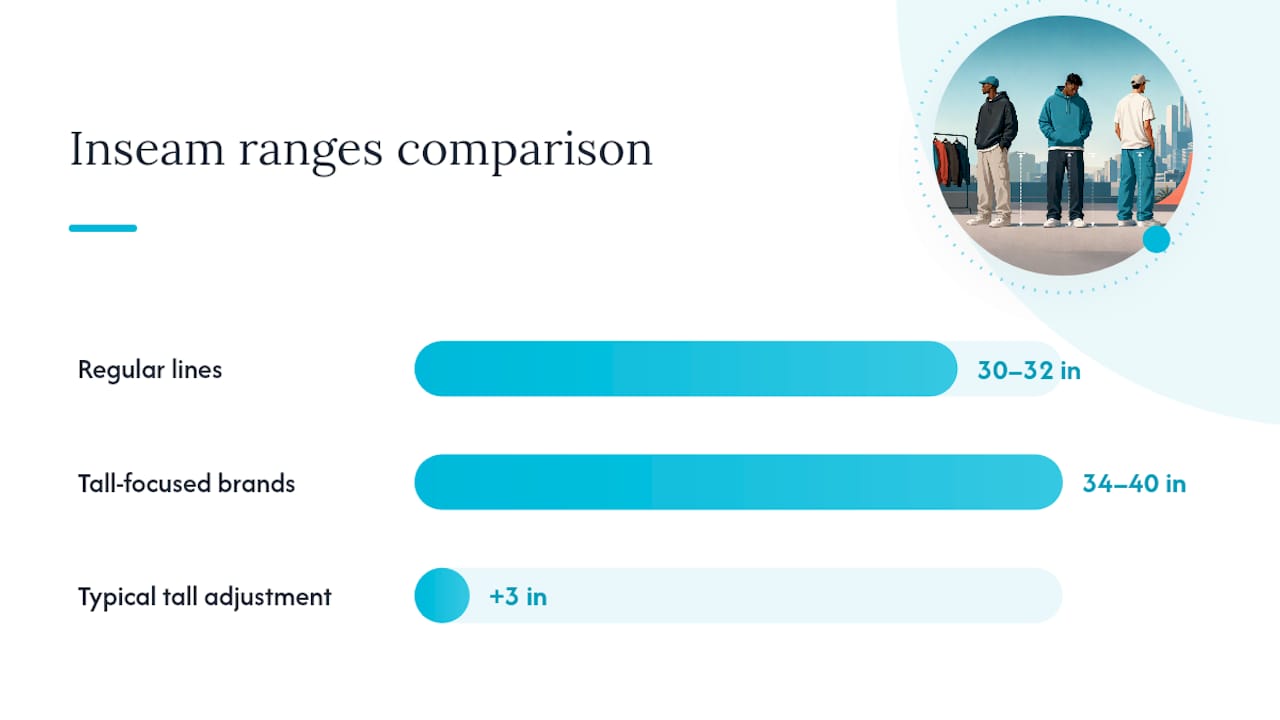
A useful shorthand here is the 3-3-3 rule: add roughly 3 inches of sleeve length, 3 inches of body length, and 3 inches of inseam over a “regular” size to land in tall-appropriate territory. It’s a starting point, not gospel. Oversized streetwear silhouettes can handle a bit more room; slim-cut pieces need tighter tolerances, so you might trim that adjustment to 2 inches.
By the numbers: tall-focused brands typically list inseams in the 34 to 40 inch range for men 6’4" and up, compared to the 30 to 32 inch inseams standard in most regular-fit lines.
Once you have your measurements, read size charts by comparing your actual sleeve and inseam numbers to the chart, not by matching your regular shirt size to a size label. If a brand doesn’t offer tall sizing, size up in the body but double-check the sleeve length still hits your wrist. When neither works, a $15 to $25 hem or sleeve alteration from a local tailor solves it permanently.
Where should you shop for tall men’s streetwear in the U.S.?
Skip any product page that doesn’t tell you exactly how long the garment is. That single detail separates brands that actually design for tall bodies from ones that just print bigger numbers on the same pattern.
Look for these signals before you check out:
- A dedicated “tall” collection or filter, not just extended sizing folded into standard categories
- Listed sleeve and body length in inches, not just “S, M, L, XL”
- Model height and the size worn, displayed directly on the product page
- Search filters like “tall,” “long inseam,” “extended length,” or “longline” that actually narrow results instead of returning the full catalog
Product pages that state a model’s height next to the size they’re wearing, a practice you’ll see on listings like BoohooMAN’s tall baggy jeans, give you a real reference point instead of a guess. That one detail cuts down on returns more than any size chart alone.
Before buying, check the return policy and domestic shipping speed. Free returns matter more here than in almost any other category, since tall-fit garments vary so much between brands that even careful measuring sometimes misses.
Muskop checks these boxes for U.S. shoppers: it’s a domestic e-commerce operation with graphic tees and streetwear staples relevant to taller frames, and it backs orders with free shipping and interest-free payment plans, removing two of the bigger friction points when you’re testing a new brand’s fit.
How can tall men style streetwear to look proportioned?
The core rule: balance a long top with something tapered or structured below it. A longline tee over baggy joggers can look like two competing silhouettes; a longline tee over tapered joggers or slim cargos reads as one deliberate line.
- Layer a longer tee under a cropped or waist-length jacket, not the other way around. This preserves the vertical line your height already gives you instead of chopping it into segments.
- Avoid stacking multiple cropped layers. One shorter piece over a longer base works; two shorter pieces together makes a tall frame look boxy.
- Chunky sneakers add visual weight at the bottom of your silhouette, which can balance a lot of upper-body volume from an oversized hoodie. Slim sneakers do the opposite: they elongate the leg line, which suits a slimmer overall fit.
Pro Tip: If you’re wearing an oversized hoodie or heavyweight tee up top, pair it with a slimmer pant. Two oversized pieces stacked on a tall frame tend to look like you’re wearing something borrowed, not something chosen.
A few formulas worth trying: for casual days, a heavyweight graphic tee with tapered joggers and chunky sneakers. For smart-casual, a longline button-up layered over a fitted tee with slim tapered trousers. For travel, a mid-length bomber over a longline hoodie with tapered cargos, which keeps you warm without adding bulk in the wrong places. Check a few streetwear essentials for more combinations that hold up on taller frames.
Why is Muskop a practical option for tall streetwear shoppers?
Muskop’s catalog runs on graphic tees, hoodies, and streetwear staples built around original artwork rather than generic basics, which gives tall shoppers more to work with when hunting for pieces that hold a print well across a longer torso. The brand backs every order with free shipping and offers interest-free payment plans, two details that matter more than they sound when you’re testing an unfamiliar size range for the first time and don’t want shipping costs eating into a return.
Before ordering, check the product page for listed body and sleeve measurements, and compare them against the numbers you took earlier. If a specific style doesn’t list a sleeve length, that’s worth confirming with customer service before you buy, since fit confidence upfront beats a return process later.
How do you tailor streetwear pieces for a better tall fit?
Even the best tall-specific brand won’t get every piece perfect for your exact proportions, and that’s where a local tailor earns their fee. Streetwear tailoring differs from suit tailoring in one important way: you’re preserving an oversized or relaxed silhouette, not tightening everything down.
Hemming is the most common fix. If joggers or jeans are half an inch short of your ideal break, a tailor can add length from a let-down hem if the fabric allows, or you simply buy the next length up and hem sleeves instead. Sleeve alterations on hoodies and jackets are trickier since drop-shoulder cuts have specific proportions, so ask a tailor experienced with streetwear, not just suiting, before you commit to a cut.
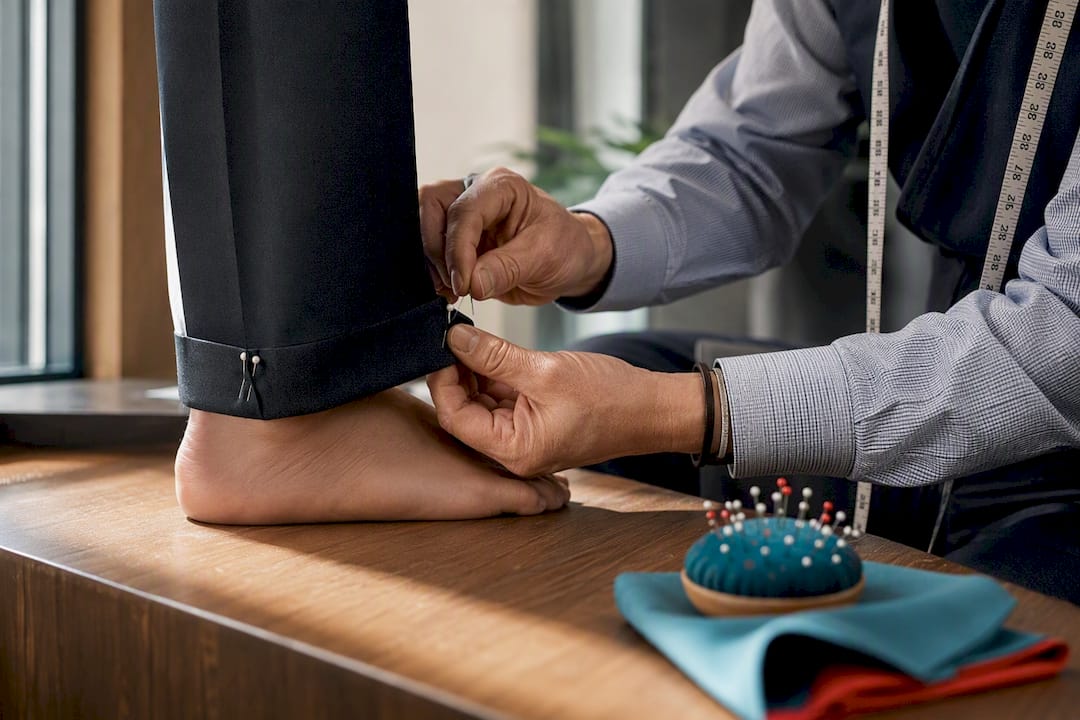
For tees, avoid altering length at all. A too-long graphic tee is far easier to live with than a too-short one, since you can tuck it or wear it untucked. If a hoodie’s body runs a size too big everywhere but the sleeves fit, a tailor can take in the side seams without touching the sleeve or hem, keeping the drop-shoulder look intact while trimming excess width.
Budget $15 to $30 for a basic hem and $30 to $50 for sleeve or side-seam work at most alteration shops. That’s usually cheaper than repeatedly returning ill-fitting pieces while you hunt for the right brand.
What footwear balances proportions for tall men?
Footwear does more heavy lifting for tall silhouettes than most guys realize. A chunky sneaker, like a dad-shoe silhouette or a thick-soled basketball-inspired shoe, adds visual weight at the floor, which grounds an oversized hoodie or wide-leg jogger instead of letting your outfit taper off into nothing at the ankle.
A slimmer sneaker, like a low-profile skate shoe or a minimal leather sneaker, elongates the leg line further, which works well when you’re already wearing tapered pants and want to emphasize height rather than balance it. If your outfit already has a lot of volume up top, pairing it with a slim shoe can make your feet look small relative to the rest of your frame.
Boots split the difference. A mid-top boot with tapered pants gives you the grounded look of a chunky sneaker with a cleaner line, which works well for smart-casual streetwear or travel outfits where sneakers feel too casual.
The general rule: match shoe volume to your top-heavy or bottom-heavy silhouette that day. Heavy top, chunky shoe. Slim top and tapered bottom, sleeker shoe. This is the same logic that shows up across influential streetwear style choices, where sneaker weight consistently gets used to balance outfit proportions rather than left as an afterthought.
How should tall men choose hats and bags for streetwear?
Accessories either extend your proportions or interrupt them, and hats are the biggest risk. A cap that sits too high or too small on a tall frame looks disconnected from the rest of the outfit, almost like it belongs to someone else. Look for adjustable snapbacks or fitted hats in larger sizes; a properly sized hat should sit low enough on your forehead to look like it’s part of the outfit, not perched on top of it.
Bucket hats and beanies scale more forgivingly across head sizes, which makes them a safer pick if you’re unsure about fit.
Bags follow a similar logic to footwear: proportion to your frame. A small crossbody bag can look undersized against a tall build with a longline hoodie, while a full-size backpack or a larger tote balances better visually. Messenger bags worn cross-body tend to work well too, since the diagonal strap line echoes the vertical lines a tall frame already has.
Keep metal hardware and logos in scale with the rest of the accessory. Oversized branding on a small bag draws attention to the size mismatch rather than away from it. When in doubt, pick one statement accessory, whether that’s a bold cap or a graphic bag, and keep the rest simple so the outfit doesn’t compete with itself.
An editorial take on dressing for height, not around it
Most style advice for tall men treats height as a problem to disguise. That’s backwards. The real issue is that most clothing is drafted for a shorter average body, then sold to everyone in the same widths. A tall guy doesn’t need to hide his height with dark colors or minimal silhouettes. He needs garments cut on the right proportions in the first place.
Where conventional advice falls short is in treating “size up” as a fix. Sizing up adds width, not length, which is the opposite of what a tall frame needs. It’s how you end up with sleeves that fit but shoulders that sag, or a torso that’s finally long enough but now three sizes too wide everywhere else.
Start with sleeve and inseam length before anything else. Chest fit is forgiving in streetwear, since drop-shoulder and oversized cuts hide a size or two of slack. Length isn’t forgiving at all. A brand that publishes real body and sleeve measurements, rather than just S through XXL labels, is telling you it actually designed for your frame instead of stretching a smaller pattern and hoping for the best.
— Robert
Try Muskop for streetwear built with tall-friendly length in mind
Everything covered here points back to one shopping habit: check the actual measurements before you check out. Muskop’s catalog of graphic tees, hoodies, and streetwear staples gives you a U.S.-based option to apply that habit to, backed by free shipping on orders and interest-free payment plans that take the financial pressure off trying a new size range for the first time.
If you’ve been stuck reworking the same regular-fit basics for years, start by comparing your own sleeve and inseam numbers against a couple of Muskop’s product listings before you buy. You’ll know within minutes whether a piece is going to hit right or fall short, and you can build a cart around what actually fits instead of guessing at a size label.
Sources
FAQ
What is the order of the three measurements to check?
Start with chest, then sleeve length, then inseam. Chest tells you if a piece fits across the body, sleeve length determines whether cuffs hit your wrist bone correctly, and inseam decides where pants or joggers end at your ankle.
Which measurement should you check first?
Chest is usually checked first since it determines whether a shirt or hoodie fits across your shoulders and torso. From there, sleeve length and inseam fine-tune the fit for a taller frame.
How do you get your three measurements?
Measure your chest around the fullest part under your arms, keeping the tape level front to back. Measure sleeve length from the center back of your neck, across the shoulder, down to your wrist bone, and measure inseam from your crotch straight down to where you want the hem to land.
What brands offer tall sizing for men?
Look for brands that list exact sleeve and body length in inches on the product page instead of just a size label, since that's the clearest sign a brand designs for taller frames rather than scaling up a regular pattern. Muskop's heavyweight tees and hoodies are worth checking if you want longer-cut streetwear basics.