

GSM stands for grams per square meter, and it’s the number that tells you how heavy or light a t-shirt’s fabric actually is. For everyday retail tees, start at 160 to 180 GSM. Go lighter for hot climates or athletic wear, and go heavier when you want structure, warmth, or a premium hand feel.
Here’s the quick breakdown:
- Lightweight (120 to 150 GSM): Summer tees, athletic cuts, anything meant to breathe.
- Midweight (150 to 180 GSM): The everyday standard. Most retail basics live here.
- Heavyweight (180 to 220 GSM): Streetwear, structured fits, premium branded merch.
- Ultra heavy (220 GSM and up): Boxy streetwear, statement pieces, cold-weather layering tees.
When you order, ask for a physical swatch, a stated tolerance (like ±5%), and confirmation of whether the GSM is measured at the finished or greige stage. That one detail avoids most sourcing headaches.
Key Takeaways
The right t shirt GSM depends entirely on use case: 160 to 180 GSM serves most everyday wear, while 180 GSM and above delivers the structure streetwear and premium basics need.
| Point | Details |
|---|---|
| Start at 160–180 GSM | This range covers most everyday retail tees for U.S. climates and casual wear. |
| Go heavier for structure | 180–220+ GSM suits streetwear, premium basics, and heavy embroidery or DTG prints. |
| Convert with 33.9 | Divide GSM by 33.9 to get oz/yd², or multiply oz/yd² by 33.9 to get GSM. |
| Always request a swatch | Same GSM can feel different depending on yarn, knit, and finishing, so test before bulk ordering. |
| Muskop favors 180–220 GSM | Muskop’s graphic tees and streetwear pieces use heavier fabric for print durability and structured fit. |
Table of Contents
- What T Shirt GSM Actually Measures
- What Are the Practical GSM Ranges for T-Shirts?
- How Do You Convert GSM to Ounces per Square Yard?
- How Does GSM Affect Comfort, Drape, and Print Quality?
- How Do You Choose the Right GSM for Your Needs?
- How Do You Measure or Verify Fabric GSM?
- Why Muskop Pays Attention to Fabric Weight
- See the GSM Behind Muskop Tees
- Frequently Asked Questions
- Sources
What T Shirt GSM Actually Measures
GSM measures fabric mass per unit area, full stop. It doesn’t measure garment quality, softness, or durability on its own. Two fabrics can share the same GSM number and feel completely different depending on the yarn used, the knit structure, and how the fabric was finished — a detail buyers often overlook.
There’s also a difference between fabric GSM and finished-garment weight. A shirt’s total weight includes trim, stitching, and labels, so a “180 GSM tee” isn’t the same as a shirt that weighs 180 grams. Brand owners specifying a tech pack should always name the test stage (finished versus greige, compacted versus uncompacted) along with the test method.
GSM at a glance: A practical starting zone for everyday retail t-shirts sits between 160 and 200 GSM, with test methods like ISO 3801 or ASTM D3776 used to verify mass per area in a lab setting.
What Are the Practical GSM Ranges for T-Shirts?
Industry sources generally break t-shirt weight into four working bands, each suited to a different job.
| GSM band | Feel | Best use |
|---|---|---|
| 120 to 150 (lightweight) | Thin, breathable, slight show-through | Summer wear, athletic tees, promotional giveaways |
| 160–180 (midweight) | Balanced, everyday comfort | Retail basics, casual wardrobe staples |
| 180–220 (heavyweight) | Structured, substantial drape | Premium basics, uniforms, streetwear |
| 220+ (ultra heavy) | Boxy, dense, almost jacket-like | Statement streetwear, oversized fits, cold-weather layering |
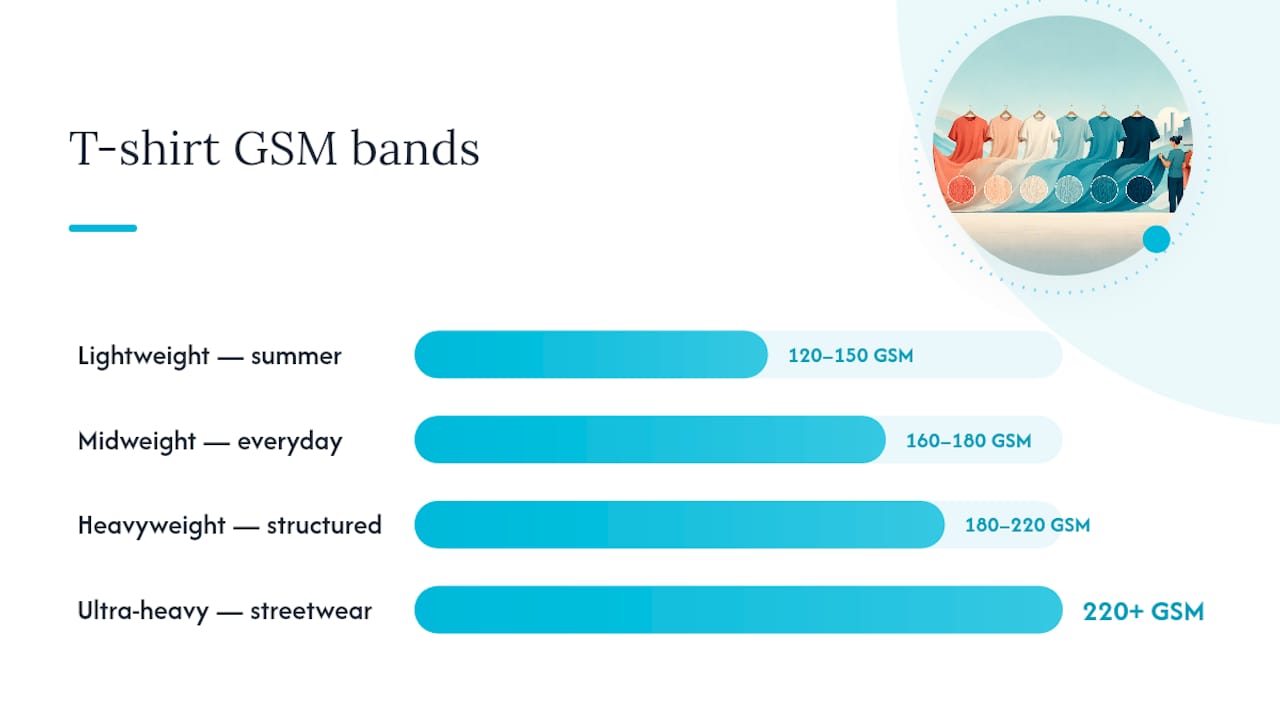
These bands track closely with what most manufacturers report as standard industry classification. For general retail, 160–180 GSM covers most everyday tees, while premium and uniform shirts typically climb to 180–220 GSM, and oversized streetwear pieces often reach 220–260+ GSM.
For brand owners choosing by decoration method:
- Screen printing and DTG (direct-to-garment) both perform well across a broad range, but decorators tend to favor 160–220 GSM for the most consistent results.
- Heavy embroidery needs a denser base fabric to support stitch weight without puckering, so stay above 180 GSM.
- If you’re a consumer shopping by climate, pick lightweight for humid summers, midweight for year-round versatility, and heavyweight if you run cold or want a tee that holds its shape after washing.
How Do You Convert GSM to Ounces per Square Yard?
American manufacturers and consumers often think in ounces, not grams, so converting matters. The formula is straightforward: divide GSM by 33.9 to get oz/yd², or multiply oz/yd² by 33.9 to get GSM.
A 5 oz/yd² fabric works out to roughly 169 GSM. Most finished adult tees land between 4.5 and 6 ounces, which lines up neatly with the midweight to heavyweight range.
How Does GSM Affect Comfort, Drape, and Print Quality?
Fabric weight changes almost everything about how a shirt performs, not just how it feels off the rack.
- Warmth: Heavier fabric traps more heat, which is great for cooler climates and layering, less great for July in Phoenix.
- Drape and structure: Lightweight cotton drapes softly and moves with the body; heavyweight fabric holds a boxier, more architectural shape.
- Opacity: Thin fabrics under 150 GSM often show bra lines, tattoos, or undershirts. Anything above 180 GSM largely solves that problem.
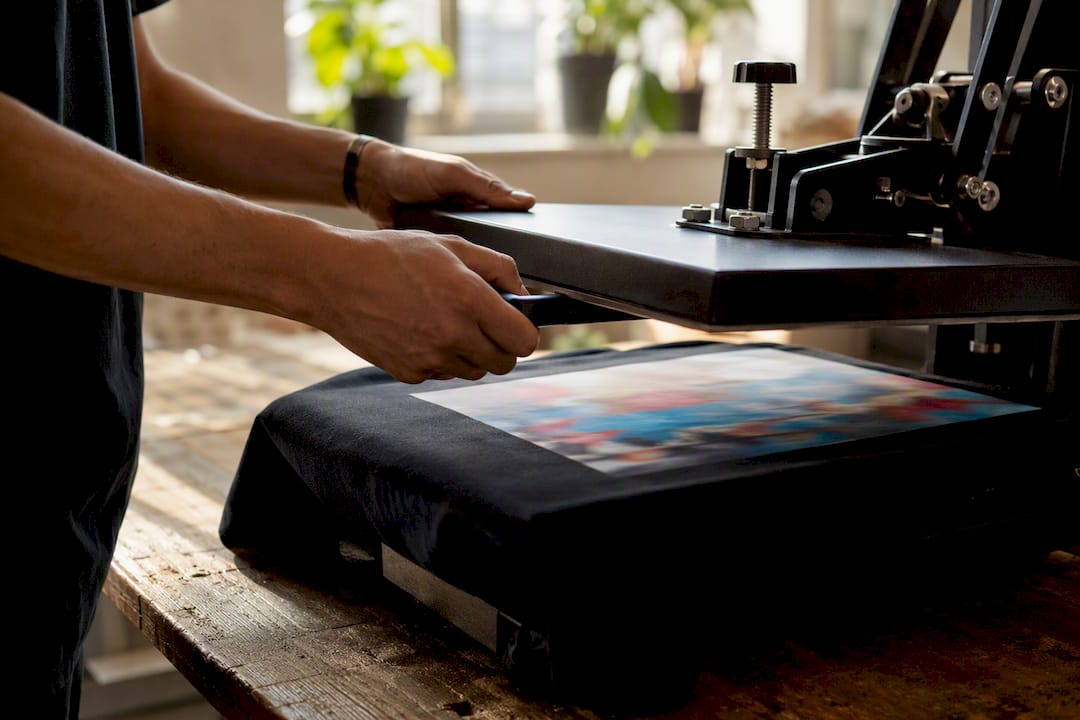
- Printing behavior: Heavier weaves absorb ink more evenly and resist puckering under large graphics, while very light fabric can pucker or scorch under high-heat transfers. A detailed comparison of decoration methods breaks down how weight interacts with screen printing versus DTG.
- Drying time and seam bulk: Lightweight tees dry fast and pack thin; heavyweight tees take longer to dry and add bulk at seams and hems.
The trade-off is simple: heavier fabric buys you structure and a premium feel, lighter fabric buys you breathability and speed. Neither is objectively better. It depends on what the shirt needs to do.
Pro Tip: If you’re running large DTG prints or dense embroidery, don’t go below 180 GSM. Lighter fabric can’t support the ink deposit or stitch density without warping.
How Do You Choose the Right GSM for Your Needs?
Start with your use case, not the number. A gym tee and a graphic streetwear piece have completely different jobs, even if they’re both cotton.
Run through this decision flow:
- Identify the use case — everyday wear, athletic performance, premium branded merch, or statement streetwear.
- Pick an initial GSM band based on that use case (see the ranges table above).
- Order a swatch before committing to bulk production.
- Run wash and print trials on that swatch to check shrinkage, colorfastness, and how it holds ink or thread.
- Finalize the spec with a target GSM, a tolerance range, and the test stage.
Before sending a tech pack, confirm you’ve included: target GSM, acceptable tolerance (commonly ±5%), fabric stage (finished versus greige), fiber composition, knit type (jersey, interlock, ribbed), and the test method used to verify it. Specifying GSM with tolerance and test stage up front saves weeks of back-and-forth with a supplier later.
Quick buyer checklist: intended use, climate, silhouette (fitted versus oversized), decoration method, opacity needs, shrinkage tolerance, and price target. Answer those six questions honestly and the right GSM band usually becomes obvious.
How Do You Measure or Verify Fabric GSM?
Labs use a standardized approach: cut a fixed-size circular sample with a GSM cutter, weigh it on a precision scale, then calculate mass per square meter. Reputable mills reference ISO 3801 or ASTM D3776 for this test, and any spec sheet should state which one was used.
You can run a rough version at home:
- Cut a 10cm by 10cm square from the fabric (0.01 square meters).
- Weigh it on a gram scale.
- Multiply the weight in grams by 100 to get GSM.
A 1.8-gram square works out to 180 GSM. It’s not lab-precise, but it’s close enough to catch a supplier who shipped the wrong weight.
Pro Tip: Never approve bulk production off a spec sheet alone. Insist on a physical pre-production swatch, since the same stated GSM can feel entirely different depending on yarn count and finishing.
Why Muskop Pays Attention to Fabric Weight
We choose GSM deliberately for every Muskop design, matching fabric weight to how a piece is meant to be worn, printed, and lived in. It’s a small decision that changes how a shirt feels for years, not just on day one.
See the GSM Behind Muskop Tees
Muskop builds its everyday graphic tees around midweight to heavyweight cotton, generally in the 180 to 220 GSM range, because that band holds bold artwork without sagging or going see-through.

For statement streetwear pieces and oversized fits, Muskop leans toward the heavier end of that range or beyond, giving the fabric enough structure to hold a boxy silhouette and enough surface density for crisp, long-lasting prints. That weight matters most when a design carries political or pop-culture artwork meant to make a statement. Thin fabric fades and distorts; heavier fabric holds ink and shape wash after wash. Browse the current lineup to see how these fabric choices show up in the actual product photos, and check individual product pages for weight details before you order your size.
Frequently Asked Questions
Is 240 GSM considered heavy for a t-shirt? Yes, it is generally regarded as ultra-heavyweight, typically used for streetwear and structured fits rather than everyday basics.
Is 250 GSM too thick for a regular t-shirt? It is notably thick and substantial, often chosen for oversized streetwear or colder climates instead of lightweight summer wear.
What GSM are most t-shirts? Most mass-market and retail tees fall between 160 and 180 GSM, the midweight range that balances comfort, durability, and print performance.
Is 180 GSM good for printing? Yes. 180 GSM sits right at the edge of the range decorators favor for screen printing and DTG, giving ink enough surface to bond without excessive stretch or puckering.
Does higher GSM always mean better quality? No. GSM measures weight, not quality. A heavy fabric with poor yarn or sloppy finishing can perform worse than a lighter, well-constructed tee.
Sources
- What GSM Means in T-Shirts: Complete Buyer Guide 2026
- What GSM is Best for T-Shirts? A Complete Guide for Brands, Printing & Wholesale Buyers - AMS Fashion House
- How Much Does a Shirt Weigh? Guide for Small Businesses (2026) - Shopify South Africa
Recommended
More questions people ask
What is the best quality GSM for a t-shirt?
There is no single best GSM since it depends on use case. For everyday retail wear 160 to 180 GSM is the standard, while 180 to 220 GSM gives more structure and is favored for streetwear and heavier prints or embroidery.
Is a 210 GSM t-shirt good or bad?
210 GSM falls in the heavyweight range of 180 to 220 GSM, which is good for structured fits, premium basics, and streetwear pieces that need a substantial drape. It is a solid choice if you want a tee that holds its shape rather than one that is light and breathable.
What does t shirt GSM mean?
GSM stands for grams per square meter and it measures how heavy or light a t-shirt's fabric is per unit of area. It tells you about fabric mass, not directly about softness or durability, since those depend on yarn, knit, and finishing too.
What GSM chart ranges are used for t-shirts?
The practical ranges run lightweight at 120 to 150 GSM, midweight at 150 to 180 GSM, heavyweight at 180 to 220 GSM, and ultra heavy at 220 GSM and up. Each band suits a different job, from breathable summer tees to boxy, cold-weather layering pieces.